The
Mechanisms of the Slippery Slope
Eugene Volokh*
(forthcoming 116 Harv. L. Rev. ___ (2003); Sept. 16,
2002 draft)
I. Introduction............................................................................................................................................................... 2
II. Cost-Lowering
Slippery Slopes and Other Multi-Peaked Preferences Slippery Slopes................................. 11
A. Cost-lowering
slippery slopes....................................................................................................................... 11
B. Cost-lowering
slippery slopes as multi-peaked preferences slippery slopes........................................ 18
C. More
multi-peaked preferences: “Enforcement
need” slippery slopes.................................................. 20
D. Equality
slippery slopes and administration cost slippery slopes.......................................................... 24
E. Multi-peaked
preferences and unconstitutional intermediate positions................................................ 37
F. The
hidden slippery slope risk and unexpected outcomes exposing multi-peaked
preferences........ 38
G. The
hidden slippery slope risk and the ad hominem heuristic................................................................. 40
III. Attitude-Altering
Slippery Slopes.......................................................................................................................... 41
A. Legislative-legislative
and judicial-legislative attitude-altering slippery slopes: The is-ought heuristic, and the normative
power of the actual.......................................................................................................................................................... 41
B. Legislative-judicial
attitude-altering slippery slopes:
“Legislative establishment of policy”............ 45
C. Just
what will people infer from past decisions?........................................................................................ 50
D. Judicial-judicial
attitude-altering slippery slopes and the extension of precedent............................... 59
E. The
attitude-altering slippery slope and extremeness aversion behavioral effects.............................. 61
F. The
erroneous evaluation slippery slope.................................................................................................... 62
G. Are
attitude-altering slippery slopes good or bad?................................................................................... 64
IV. Small
Change Tolerance Slippery Slopes.............................................................................................................. 65
A. Small
change apathy, small change deference, and rational apathy....................................................... 66
B. Small
change tolerance and the desire to avoid seeming extremist or petty.......................................... 69
C. Judicial-judicial
small change tolerance slippery slopes and the extension of precedent................... 71
V. Political
Power Slippery Slopes............................................................................................................................... 73
A. Examples........................................................................................................................................................... 73
B. Types
of political power slippery slopes..................................................................................................... 76
VI. Political
Momentum Slippery Slopes..................................................................................................................... 78
A. Political
momentum and effects on legislators, contributors, activists, and voters.............................. 79
B. Reacting
to the possibility of slippage—the slippery slope inefficiency and the ad
hominem heuristic 83
VII. Implications
and Avenues for Future Research................................................................................................... 84
A. Considering
Slippery Slope Mechanisms in Decisionmaking and Argument Design.......................... 85
B. Thinking
About the Role of Ideological Advocacy Groups.................................................................... 86
C. Fighting
the Slippery Slope Inefficiency..................................................................................................... 88
D. Slippery
Slopes and Precedent...................................................................................................................... 89
E. Empirical
Research: Econometric, Historical, and Psychological............................................................. 89
F. When
(If Ever) Should We Avoid Slippery Slope Reasoning?............................................................... 90
VIII. Conclusion................................................................................................................................................................. 91
“In other countries [than the American colonies], the people . . . judge of an ill principle in government only by an actual grievance; here they anticipate the evil, and judge of the pressure of the grievance by the badness of the principle. They augur misgovernment at a distance and snuff the approach of tyranny in every tainted breeze.”
— Edmund Burke, On Moving His Resolutions for Conciliation
with the Colonies, Speech to Parliament,
I.
Introduction
You are a legislator, a voter, a judge, a commentator, or an advocacy group leader. You need to decide whether to endorse decision A, for instance a partial-birth abortion ban, a limited school choice program, or gun registration.
You think A, on its own, might be a fairly good idea, or at least not a very bad one. But you’re afraid that A might eventually lead other legislators, voters, or judges to support B, which you strongly oppose—for instance, broader abortion restrictions, an across-the-board school choice program, or a total gun ban.
What does it make sense for you to do, given your opposition to B, and given your awareness that others in society might not share your views? Should you heed James Madison’s admonition that “it is proper to take alarm at the first experiment on our liberties,”[1] and firmly oppose something that you might have otherwise supported were it not for your concern about the slippery slope? Or should you accept the immediate benefits of A, and trust that even after A is enacted, B will be avoided?
Slippery slopes are, I will argue, a real cause for concern, as legal thinkers such as Madison, Jackson, Brennan, Harlan, and Black have recognized.[2] And these arguments comport at least partly with our own experience: We can all identify situations where a first step A has led to a later step B that might not have happened without A, though we may disagree about exactly which situations exhibit this quality.[3] A may not logically require B—but for political and psychological reasons, it can help bring B about.[4]
But, as legal thinkers such
as
This need makes many people impatient with slippery slope arguments.[6] The slippery slope argument, the flip response goes, is the claim that “we ought not make a sound decision today, for fear of having to draw a sound distinction tomorrow.”[7] To critics of slippery slope arguments, the arguments themselves sound like a slippery slope: If you accepted this slippery slope argument, then you’d end up accepting the next one and then the next one until you eventually slip down the slope to rejecting all government power (or all change from the status quo), and thus “break down every useful institution of man.”[8] Exactly why, they ask, would accepting, say, a restriction on “ideas we hate” “sooner or later” lead to restrictions on “ideas we cherish”?[9] If the legal system is willing to protect the ideas we cherish today, why wouldn’t it still protect them tomorrow, even if we ban some other ideas in the meanwhile? And of course, even if one thinks slippery slopes are possible, what about cases where the slope seems slippery both ways—where both alternative decisions seem capable of leading to bad consequences in the future?[10]
My aim here is to analyze how we can sensibly evaluate the risk of slippery slopes, a topic that has been surprisingly underinvestigated.[11] I think the most useful definition of slippery slopes is a broad one, which covers all situations where decision A, which you might find appealing, ends up materially increasing the probability that others will bring about decision B, which you oppose.[12] If you are faced with the pragmatic question “Does it make sense for me to support A, given that it might lead others to support B?,” it shouldn’t much matter to you whether A would lead to B through logical mechanisms or psychological ones, through judicial ones or legislative ones, or through a sequence of short steps or one sharp change. Nor should it matter to you whether or not A and B are on a continuum where B is in some sense more of A, a condition that would in any event be hard to define precisely.[13]
The question is whether A might lead to some harmful decisions in the future, through whatever mechanisms. To answer this question, we need to think—without any artificial limitations—about the entire range of possible ways that A can change the conditions (whether those conditions are public attitudes, political alignments, costs and benefits, or what have you) under which others will consider B.
The slippery slope is a familiar label for many of the most common examples of this phenomenon: When someone says “I oppose partial-birth abortion bans because they might lead to broader abortion restrictions,” or “I oppose gun registration because it might lead to gun prohibition,” the common reaction is “That’s a slippery slope argument.” But whatever one calls these arguments, the important point is that the observer is asking the question “Does it make sense for me to support A, given that it might lead others to support B?,” which breaks down into “How much do I like A?,” “How much do I dislike B?,” and, the focus of this article, “How likely is A to lead others to support B?”[14] And this last question in turn requires us to ask “What are the mechanisms through which A can lead others to support B?”
![Text Box:
Camel (A) sticks his nose under the tent (B), which collapses, driving the thin end of the wedge (C) to cause monkey to open floodgates (D), letting water flow down the slippery slope (E) to irrigate acorn (F) which grows into oak (G). [Illustration by Eric Kim, from author’s idea.]](slippery_files/image002.gif)
It is these real-world mechanisms on which I will focus.[15] Slippery slopes, camel’s noses, thin ends of
wedges, floodgates, and acorns are metaphors, not analytical tools. My goal is to describe the real-world paths
that the metaphors represent—to provide a framework for analyzing and
evaluating slippery slope risks by focusing on the concrete means through which
A might possibly cause B.
Specifically, I want to make the following claims, which are closely related but which are worth highlighting separately:
1. Though the metaphor of the slippery slope suggests that there’s one fundamental mechanism through which the slippage happens, there are actually many different ways that decision A can make decision B more likely. Many of these ways have little to do with the mechanisms that people often think of when they hear the phrase “slippery slope”: development by analogy, by decision A changing people’s moral or empirical assumptions about B, or by people becoming “desensitized” to decision B.[16]
To illustrate this briefly, consider the claim that gun registration (A) might lead to gun confiscation (B).[17] Setting aside whether we think this slippery slope is likely—and whether it might actually be desirable—it turns out that the slope might happen through many different mechanisms, or combinations of mechanisms:
- Registration may change people’s attitudes about the propriety of confiscation, by making them view gun possession not as a right but as a privilege that the government grants and therefore may deny.
- Registration may be seen as a small enough change that people will reasonably ignore it (“I’m too busy to worry about little things like this”), but when aggregated with a sequence of other small changes, registration can ultimately lead to confiscation, or something close to it.
- The enactment of registration requirements can create political momentum in favor of gun control supporters, thus making it easier for them to persuade legislators to enact confiscation.
- Non-gun-owners are more likely than gun owners to support confiscation.[18] If registration is onerous enough, over time it may discourage some people from buying guns, thus diminish the fraction of the public that owns guns, diminish the political power of the gun-owner voting bloc, and increase the likelihood that confiscation will be politically feasible.
- Registration may lower the cost of confiscation—since the government would know which people’s houses to search if the residents don’t turn in their guns voluntarily—and thus make confiscation more appealing.
- Registration may trigger the operation of other legal rules that make confiscation easier and thus more cost-effective: When guns aren’t registered, confiscation would be largely unenforceable, since house-to-house searches to find guns would violate the Fourth Amendment; but if guns are registered some years before confiscation is enacted, the registration database might provide probable cause to search the houses of all registered gun owners.[19]
I think that in the registration-to-confiscation scenario, only the latter two mechanisms are fairly plausible; in other scenarios, others may be more plausible. But the important point is that being aware of all these mechanisms can help us as citizens and policymakers think through all the possible implications of some decision A—and can help us as advocates make more concrete and effective arguments for why A would (or would not) lead to B. And even if you are skeptical of one kind of slippery slope claim, you may find that the others are worth considering.
2. As the above example illustrates, slippery slopes are not limited to judicial-judicial ones, where one judicial decision leads to another through the force of traditional judicial precedent. They can also be legislative-legislative, where one legislative decision leads to another (Madison’s concern in his famous Remonstrance Against Religious Assessments[20]), judicial-legislative, and legislative-judicial.
3. Slippery slopes may occur even when a principled distinction could be drawn between decisions A and B. The question isn’t “Can we draw the line between A and B?,”[21] but “Is it likely that other citizens/judges/legislators will draw the line there?”[22]
More broadly, the question ought not be “How should society [or the legal system] decide whether to implement A?” Societies are composed of people who have different views, so one person or group of people may find it worthwhile to oppose A for fear of what others would do if A is accepted. And these others need not constitute all or even most of society—slippery slopes can happen even if A will lead only a significant minority of voters to support B, if that minority is the swing vote.
4. In a stylized world in which voters or legislators are fully rational, have unlimited time to invest in political decisions, and have single-peaked preferences (more on this in Part II.B), slippery slopes turn out to be unlikely. In such a world, if B is unpopular today, it will continue to be unpopular tomorrow, whether or not A is enacted; enacting A therefore won’t cause any slippage to B. Part of the skepticism about slippery slopes may come from the common tendency to assume that we are living in this stylized world, an assumption that is indeed often a sensible first-order approximation.
It turns out, though, that the mechanisms of many slippery slopes are closely connected to phenomena that contradict these simplifying assumptions: bounded rationality, rational ignorance, heuristics that people develop to deal with their bounded rationality, irrational choice behaviors such as context-dependence, and multi-peaked preferences. And since these latter conditions are common in the real world of voters, legislators, and judges, slippery slopes are more likely than one might at first think.
5. Slippery slopes are also connected to path dependence.[23] Once law B has been enacted, it’s often easy to assume that it was predetermined by powerful social forces that no one could have derailed. But path dependence suggests that sometimes a decision A can shift the evolution of a legal rule from one course to another, bringing about a B that would not have otherwise happened. The study of slippery slopes can thus illuminate forms of path dependence that haven’t yet been fully investigated,[24] and the study of path dependence can help illuminate the slippery slope phenomenon.[25]
6. One kind of slippery slope—the attitude-altering slippery slope—is connected to expressive theories of law.[26] “The law,” these theories suggest, “affects behavior by what it says rather than by what it does”;[27] a classic example is bans on smoking in public places helping strengthen a no-smoking-in-public-places norm even when public smoking is rarely legally punished. The attitude-altering slippery slopes would happen when the expressive power of law changes people’s political behavior as well, by leading them to accept new proposals B that they would have rejected before.
7. The existence of the slippery slope creates what I call the slippery slope inefficiency: Decision A may itself be socially beneficial, and many people might agree that it’s beneficial; but the reasonable concern that A will lead to B might prevent the decision from being implemented.[28] One corollary of the inquiry “How likely is A to lead B?” is the inquiry “How can we make it less likely that A will lead to B, so that we can get agreement on A despite some people’s concern about B?” I will propose a few hypotheses along these lines:
- Substantive constitutional rights and limits on government powers can be regulation-enabling, not just regulation-frustrating. A constitutional right to get an abortion, to speak, or to own guns can free people to vote for small (and constitutionally permissible) burdens on the right with less concern that these small steps will lead to broader constraints.[29]
- On the other hand, constitutional equality rights—under the Equal Protection Clause, the Free Speech Clause, or other provisions—are themselves means by which decision A may lead to decision B, if a court concludes that implementing A but then failing to implement B would violate the equality rule.[30] Deferential equality tests, such as the current weak rational basis test applicable to many equal protection claims, thus prevent a particular form of slippery slope.[31]
8. People often evaluate the potential downstream effects of proposals through rules of thumb. Recognizing slippery slope concerns might lead us to change our heuristics;[32] again, here are a few hypotheses:
- People often urge others not to make a big deal out of small burdens: If a new proposal seems to have low costs (to liberty or the public fisc), it should be supported, or at least not strongly opposed, even if it might have low likely benefits.[33] This, for instance, is what many say about modest restrictions on privacy, gun ownership, and other behavior—the restrictions may not offer huge safety benefits, but they aren’t serious restraints on rights, either, so why not try them? Maybe the experiment will pleasantly surprise us, or give us some helpful information about which proposals work and which don’t. And beyond this, fighting this modest experiment might make us seem foolishly intransigent—an argument often levied against abortion rights or gun rights “extremists.”
But the more we believe that the one step now may lead to other steps later, the more we should view such experimentation with concern. We might therefore adopt a rebuttable presumption against even small changes, under which we oppose any proposal A (in certain fields) unless we see it as having really great benefits, because even a seemingly modest restriction has the added cost of increasing the chances of broader restrictions B in the future. And this concern, if it can be persuasively articulated, can provide a response to the “You’re an extremist” argument.
- We are often cautioned against ad hominem arguments, and against impugning our political opponents’ motives, and there is much to these cautions. Nonetheless, the existence of some slippery slope mechanisms may suggest that what one might call an ad hominem heuristic—a policy of presumptively opposing even minor proposals made by certain groups that are also known to support broader proposals, unless the proposal clearly seems to be very good indeed—may be more pragmatically rational than one might think.[34]
9. These heuristics may also shed light on the behavior of advocacy groups such as the ACLU or the NRA. Public consciousness of the possibility of slippage may help prevent the slippage, either by preventing the first steps or by building opposition to the subsequent ones; and one role of advocacy groups is to alert the public to the slippery slope risks, partly by trying to instill the just-mentioned heuristics. This strategy can be dangerous for such groups, because it may make them seem extremist. But, as I discuss throughout and summarize in Part VII.B, such a strategy may be made necessary by the real slippery slope risks that these groups are trying to combat.
10. Thinking about legislative slippery slopes might illuminate two aspects of judicial decisionmaking: reliance on precedent (where judicial-judicial slippery slopes may appear) and deference to the legislature (where legislative-judicial slippery slopes may operate). These parts of the judicial process, it turns out, are closely connected to analogous processes in legislative decisionmaking.[35]
11. Thus, slippery slopes are a real problem, not always but often enough that we cannot lightly ignore the possibility of such slippage. “In the absence of absolute knowledge and consequently absolute control over the consequences of our actions and decisions, we cannot afford to ignore the possible misuses of proposed reforms.”[36]
* * *
The analysis which follows will go through the different kinds of slippery slopes that I have identified (Parts II-VI), illustrating each with a variety of hypotheticals based on real controversies—I hope that readers will find at least some of these illustrations plausible, and will conclude that slippery slopes are possible (even if not certain) in some of these situations.[37] Part VII then briefly summarizes how this analysis might be applied to thinking about ideological advocacy groups, evaluating the likelihood of slippage, crafting slippery slope arguments and counterarguments, avoiding the slippery slope inefficiency, understanding the operation of judicial precedent, and designing future econometric, historical, or psychological research about slippery slopes.
II.
Cost-Lowering
Slippery Slopes and Other Multi-Peaked Preferences Slippery Slopes
A. Cost-lowering slippery slopes
1. An example
Let’s begin with the slippery slope question mentioned in the Introduction: Does it make sense for someone to oppose gun registration (A) because registration might make it likelier that others will enact eventual gun confiscation (B)?[38] A and B are logically distinguishable; but can A help lead to B despite that?
Today, when the government doesn’t know where the guns are, gun confiscation would require searching all homes, which would be very expensive; relying heavily on informers, which may be unpopular; or accepting a probably low compliance rate, which may make the law not worth its potential costs.[39] And searching all homes is expensive both financially and politically, since the searches will annoy many people, including some of the non-gun-owners who might otherwise support a total gun ban.[40]
On the other hand, if guns are registered, a search of all registrants would be both financially and politically cheaper, especially if the law bans one type of gun, covers only a region where they are already fairly uncommon, and perhaps covers only a subset of the population (e.g., public housing residents[41]). Gun registration has been eventually followed by confiscation in England, New York City, and Australia;[42] while it’s impossible to be sure that the registration helped cause confiscation, it seems likely that people’s compliance with the registration requirement made the confiscation easier to implement, and therefore likelier to be enacted. And Handgun Control, Inc. founder Pete Shields openly described registration as a preliminary step to confiscation, though he didn’t describe exactly how the slippery slope mechanism would operate.[43]
Under some conditions, then, legislative decision A may lower the cost of making legislative decision B work, and thus make decision B cost-justified in the decisionmakers’ eyes.[44] There’s no requirement here that A be seen as a precedent, or that A change anybody’s moral or pragmatic attitudes—only that it lower certain costs, here by giving the government information.[45]
2. A diverse preferences explanation for cost-lowering slippery slopes
The cost-lowering slippery slope is driven by voters having a particular mix of preferences; a numerical example might help demonstrate this.
Consider a proposal to put video cameras on street lamps, in order to help deter and solve street crimes. There are obvious limits to this plan, but though it isn’t perfect, it seems promising: Smart criminals will be deterred, and dumb ones will be caught.
And on its own, the plan might not seem that susceptible to police abuse, at least so long as the tapes are recycled, say, every 24 hours, and so long as the cameras aren’t linked to face-recognition software: Under those conditions, the tapes might be effective for fighting low-level street crime, but they wouldn’t make it that easy for the police to track the government’s enemies.[46] People might thus support installing these cameras (decision A), even if they would oppose the use of face-recognition software or the permanent archiving of these tapes (decision B).[47]
But once the legislature implements A, and the government invests money in installing thousands of cameras, in wiring them to the central video recorders or at least to phone lines, and in protecting them from vandals, implementing B becomes much cheaper economically, and thus easier politically. Imagine that, if money were no object, voters would have the following (obviously highly stylized) mix of opinions:
· 20% of the public would oppose even decision A, because they don’t want the police videotaping street activity at all;
· 20% of the public would support A but oppose B, because they like videotaping only if tapes are quickly recycled and no face recognition software is used;
· 60% of the public would support B, because they like police videotaping more generally, and would certainly support A if that’s all they can get.
But imagine that 30% of the second and third groups would nonetheless oppose decisions A and B because they cost too much. The mix of preferences would thus be:
|
# |
Preference |
Would support in principle and given the cost (e.g., if there are no cameras yet, and we’re in position 0) |
Would support in principle, if there were no extra cost (e.g., if there are already cameras up, because A was already implemented) |
|
1 |
0: no cameras |
20% |
20% |
|
2 |
A: cameras, no face recognition and no archiving |
14% |
20% |
|
3 |
B: cameras, with face recognition and archiving |
42% |
60% |
If the people in group 2 focus only on the vote on A, those of them who don’t mind the financial cost would vote “yes”; and with group 2’s 20% ´ 70% + group 3’s 60% ´ 70% = 56% of the vote, A would get enacted.[48] But a few years later, when someone suggests a switch to B at no extra cost, that proposal would also be enacted, since 60% of the public would now support it, given that there’s no more fiscal objection.
Thus, the group 2 people must make a tough choice: Do they like A so much that they’re willing to accept the risk of B as well, or are they so concerned about B that they’re willing to reject A? The one item that is off the table is the one group 2 most prefers, which is A alone. The cost-lowering slippery slope has eliminated that possibility, at least unless there’s a constitutional barrier to B, or unless the government can somehow set up special cameras that would be very expensive to convert to mode B.
3. Cost-lowering slippery slopes, the costs of uncertainty, and learning curves
The above example involves the cost of tangible material—cameras. But another cost of any new project is the cost of learning how to properly implement it, and the related risk that it will be implemented badly.
Many new proposals, from social security privatization to education reform are viewed skeptically on these very grounds, at least by some. Broad change B—for instance, an across-the-board school choice program—might thus be opposed by a coalition of (1) people who oppose it in principle (for instance, because they don’t want tax money going to religious education, or because they want to maintain the primacy of government-run schools), and (2) those who might support it in theory but suspect that it would be badly implemented in practice.[49] This lineup is similar to what we saw in the camera example.
But say that someone proposes a relatively modest school choice program A, for instance one that is limited to nonreligious schools, or to children who would otherwise go to the worst of the government-run schools.[50] Some people might support this project, because it has value on its own. But as a side effect of A, people will learn how school choice programs can be properly implemented, for instance what sorts of private schools should be eligible, how (if at all) they should be supervised, and so on.
If A is a total failure, then voters may become even more skeptical about the broader proposal B. But if after some years of difficulty, the government eventually creates an A that works fairly well, some voters might become more confident that the government—armed with this new knowledge derived from the A experiment—can implement B more effectively.
A will thus have led to a B that, were it not for A, might have been avoided. In the path dependence literature, this is described as a form of “increasing returns path dependence” that focuses on “learning effects”: “In processes that exhibit . . . characteristics [such as learning effects], a step in one direction decreases the cost (or increases the benefit) of an additional step in the same direction, creating a powerful cycle of self-reinforcing activity or positive feedback.”[51] And because of this increasing returns path dependence, “decisions may have large, unanticipated, and unintended effects.”[52]
For those who support broad school choice (B) in principle, this is good: The experiment with A will have led some voters to have more confidence that B would be properly implemented, and thus made enacting B more politically feasible.
But, as with the cameras example, those who support A but oppose B in principle might find that their voting for A has backfired. Some of A’s supporters might therefore decide to vote strategically against A, given the risk that A would lead to B. The government, they might reason, ought not know how to efficiently do bad things like B (bad in the strategic voter’s opinion), precisely because the knowledge can make it likelier that the government will indeed do these bad things.
4. Legal-cost-lowering slippery slopes
Let us return briefly to the “gun registration may increase the chances of gun confiscation” argument. Today, gun confiscation would be hard to enforce, among other things because of the Fourth Amendment.[53] Searching all houses for some or all kinds of guns would today be unconstitutional, close to the paradigm of an impermissible general search.[54] This is in a sense a cost of confiscation—not a financial cost, but a legal cost that keeps confiscation from being performed efficiently.[55]
If, however, guns are successfully registered, a house-to-house search of registered owners’ homes may well become constitutional. Your registration as the owner of a weapon may be seen as creating probable cause to believe that you have it; and one place you’re likely to keep it is your home. This isn’t a certainty—maybe the gun was stolen or lost, and you didn’t report this to the police, or maybe you’re keeping the gun in some other location—but a magistrate may find that it suffices for probable cause, and issue a search warrant that would let the police search your house for the gun.[56]
Gun registration (legislative decision A) thus leads to some degree of public compliance with the registration requirement. This compliance has the legally significant effect of creating probable cause to search all registrants’ houses, once guns are banned. This legally significant effect makes it easier to enforce the gun ban—and thus makes it likelier that such a ban will be enacted (legislative decision B).
Again, this scenario doesn’t require us to assume that registration will be seen as morally indistinguishable from confiscation, or that registration will set a precedent, or that registration will desensitize voters to confiscation. Decision A can make B likelier even if it doesn’t change a single voter’s, legislator’s, or judge’s mind about the moral propriety of gun prohibition or confiscation. Rather, the legally significant effect of registration can change the practical cost-benefit calculus surrounding prohibition, and thus make prohibition more likely (though of course not certain).[57]
5. Being alert to the risk of cost-lowering slippery slopes
This suggests that decisionmakers—legislators, voters, advocacy groups, or opinion leaders deciding whether to oppose a particular proposals—should consider how a government action would change the costs of implementing future actions, in particular:
· How would this government action provide more information to the government (e.g., who owns the guns), and what other actions (e.g., seizing the guns) would be made materially cheaper by the availability of this information?
· How would this government action provide more tools to the government (e.g., video cameras), and what other actions (e.g., automated face recognition, videotape archiving) would be made cheaper by the existence of these tools?[58]
·
How would
this government action provide more
experience to the government in doing certain things, and what other
actions would this extra experience make less risky and thus more politically
appealing?
·
How would this government action provide more legal power to the government
(e.g., the power to search people’s homes), and what other actions would this
extra grant of power make possible or make easier?
Opponents of B can’t
simply console themselves with the possibility that a reasonable line between A
and B can logically be drawn, to
dismiss the slippery slope concern as being that “we ought not make a sound decision today, for fear of having to draw a
sound distinction tomorrow,”[59]
or to argue that
Someone who trusts in the checks and balances of a democratic society in which he lives usually will also have confidence in the possibility to correct future developments. If we can stop now, we will be able to stop in the future as well, when necessary; therefore, we need not stop here yet.[60]
There’s a different “we” involved: Those who support A but oppose B should fear that if they vote for A now, such a vote may lead others to vote for B later—and that though a logical line could be drawn between A and B (yes cameras, no archiving, no face recognition), most voters will decide to draw the line on the far side of B rather than on the near side. Even those who generally trust that their society is democratic can thus rationally oppose a decision that they like on its own, for fear that it will lower the cost of another decision that they dislike, and thus make that decision more likely.
6. Constitutional rights as tools for preventing the slippery slope inefficiency
The examples above illustrate the Slippery Slope Inefficiency: Even if a majority of voters believe decision A (e.g., gun registration) is good policy on its own, A may be rejected because enough of those voters fear that A will lead to B (gun prohibition), which they oppose.[61] And the examples point to one possible way of preventing the inefficiency—courts recognizing constitutional rights that would prevent B, such as a non-absolute right to own guns.[62] Once this constitutional precommitment makes B much less likely, opponents of B thus have less to fear (to the extent they trust the courts) and can thus support A, or at least oppose it less.
Constitutional constraints are thus not only legislation-frustrating (because they prohibit total bans on guns) but also in some measure legislation-facilitating (because some voters may support more modest gun controls, once they stop worrying that these controls will lead to a total ban). Changing a constitution to secure a right may thus sometimes be good both for some who want to moderately protect the right and for some who want to moderately restrict it—though naturally much depends on how broad the right would be, and on what political power the various groups have.[63]
B. Cost-lowering slippery slopes as multi-peaked preferences slippery slopes
Cost-lowering slippery slopes, it turns out, are a special case of a broader mechanism—the multi-peaked preferences slippery slope.
In many debates, one can roughly divide the public into three groups: traditionalists, who don’t want to change the law (they like position 0), moderates, who want to shift a bit to position A, and radicals, who want to go all the way to position B. What’s more, one can assume “single-peaked preferences”:[64] Both traditionalists and radicals would rather have A than the extreme on the other side. We can represent the preferences the following way, which is why the preferences are called “single-peaked”:
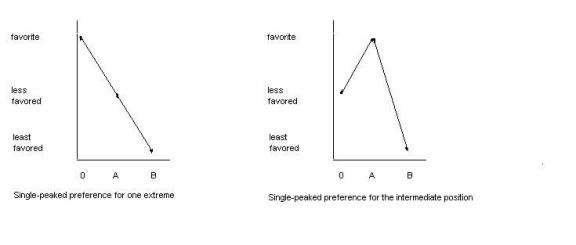
If neither the traditionalists nor the radicals are a majority, the moderates have the swing vote, and thus needn’t worry much about the slippery slope. Say that 30% of voters want no street-corner cameras (0), 40% want cameras but no archiving and face recognition (A), and 30% want archiving and face recognition (B). The moderates can join the radicals to go from 0 to A; and then they can join the traditionalists to stay at A instead of going to B. So long as people’s attitudes stay fixed, there’s no slippery slope risk:[65] Those who prefer A can vote for it with little risk that A will enable B.
But say instead that some people would prefer 0 best of all (they’d rather have no cameras, because they think installing cameras costs too much), but once cameras are installed they would think that position B (archiving and face recognition) is better than A (no archiving and no face recognition): “If we spend the money for the cameras,” they reason, “we might as well get the most bang for the buck.” This is a multi-peaked preference—these people like A least of all, preferring either extreme over the middle.
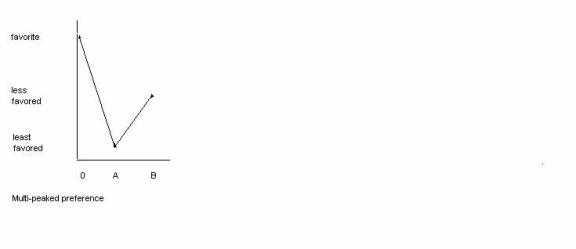
Let’s also say that shifting the law from one position to another requires a mild supermajority, say 55%; a mere 50%+1 vote isn’t enough, because the system has built-in brakes (such as the requirement that the law be passed by both houses of the legislature, the requirement of an executive signature, or a more general bias in favor of the status quo).[66] We can thus imagine the public (or the legislature) split into several different groups, each with its own policy preferences and its own voting strength.
|
Group |
Most prefers |
Next preference |
Most dislikes |
Attitude |
Voting Strength |
|
1 |
0 |
A |
B |
“As little surveillance as possible, either (1) as a
matter of principle, or (2) because we prefer surveillance level A as a
matter of principle, but think cameras are too expensive” |
26% (20% for (1) + 6% for (2)) |
|
2 |
0 |
B |
A |
“Cameras are too expensive, but if the money is spent,
might as well get as much surveillance for it as possible” |
18% |
|
3 |
A |
0 |
B |
“We prefer moderate surveillance level A, and
definitely no more” |
14% |
|
4 |
A |
B |
0 |
“We prefer surveillance level A, and definitely no
less” |
0% (in this example) |
|
5 |
B |
0 |
A |
“We want maximum surveillance, but if we can’t have
that, we’d rather have no surveillance instead of A” |
0% |
|
6 |
B |
A |
0 |
“We want maximum surveillance, and cost isn’t a
concern” |
42% |
This is exactly the same preference breakdown as in the simpler table on p. 13; and, as in that table, the direct 0®B move fails, because it gets only 42% of the vote (group 6), but the 0®A move succeeds with 56% of the vote (groups 3 and 6) and then the A®B move succeeds with 60% of the vote (groups 2 and 6).[67] And, as before, members of group 3 must now regret their original vote for the 0®A move, because that vote helped bring about result B, which they most oppose.
Multi-peaked preferences thus make the moderate position A politically unstable—which means that implementing A can grease the slope for a B that would otherwise have been blocked.
C. More multi-peaked preferences: “Enforcement need” slippery slopes
“As first and moderate methods to attain unity have failed, those bent on
its accomplishment must resort to an ever-increasing severity. . . . . Those who begin coercive elimination of
dissent soon find themselves exterminating dissenters. . . . [T]he First Amendment to our Constitution was
designed to avoid these ends by avoiding these beginnings.”
— West Va. State Bd. of Ed. v. Barnette, 319 U.S. 624 (1943) (Jackson, J.).
There are many possible multi-peaked preferences slippery slopes besides the cost-lowering slippery slope; one example is the enforcement need slippery slope.
Imagine marijuana is legal, and the question is whether to ban it. Some prefer to keep it legal (0), others want to ban it but enforce the law mildly (A), and others want to ban it and enforce the law severely, with intrusive searches and strict penalties (B).
But say also that some people would prefer 0 best of all (they’d rather keep marijuana legal), but once marijuana is outlawed they would think that position B (strict enforcement) is better than A (lenient enforcement). “Laws should be enforced,” they might argue, “because not enforcing them only teaches people that law was meaningless and that they can violate all sorts of laws with impunity.” Obviously, if they thought the law is extremely bad, they would have preferred that it be flouted with impunity than have it be strictly enforced. But let’s assume they think the law is only slightly unwise, whereas leaving such a law unenforced is very unwise.[68] We again see a multi-peaked preference—people like A least, preferring either extreme over the middle.
Let’s assume, as before, that it takes at least a 55% supermajority to shift from the status quo,[69] and let’s assume that the group breakdown is as follows:
|
Group |
Most prefers |
Next preference |
Most dislikes |
Attitude |
Voting Strength |
|
1 |
0 |
A |
B |
“Restrict drugs as little as possible” |
10% |
|
2 |
0 |
B |
A |
“Restricting drugs is bad, but contempt for the law
is even worse” |
20% |
|
3 |
A |
0 |
B |
“A little restriction is good, but hard-core
enforcement is very bad” |
20% |
|
4 |
A |
B |
0 |
“A little restriction is good, and having no
restriction is very bad” |
10% |
|
5 |
B |
0 |
A |
“Drugs are bad, but contempt for the law is even
worse” |
10% |
|
6 |
B |
A |
0 |
“Drugs are bad, do as much as you can to stop them” |
30% |
Given these preferences, a proposal to shift from position 0 (marijuana legal) to B (a sternly enforced marijuana ban) would fail: It would get the votes of groups 4, 5, and 6, only 50%. But a proposed 0®A shift (to a weakly enforced ban) would succeed, with a 60% supermajority coming from groups 3, 4, and 6. Once A is enacted, then a proposed A®B shift would also succeed, with the votes of groups 2, 5, and 6, also 60%. And then shifting from B back to 0 would be impossible, since such a proposal would only get the votes of groups 1, 2, and 3, just 50%.[70]
Decision A wouldn’t change anyone’s underlying attitudes; rather, it would lead one small but important swing group (the 20% of the voters in group 2) to vote for B, based on their preexisting preference for B over A, even though the group would have opposed B had the status quo remained at 0.[71] Even when only a minority of voters (30%, groups 2 and 5) exhibit multi-peaked preferences, and an even smaller minority take the enforcement need view that “we don’t much like the law but we dislike people flouting the law even more” (20%, group 2), A can cause slippage to B.[72]
The lesson, then, is for the moderates in group 3, who like A but worry that their supporting A would eventually help bring about B, which they dislike. They should ask themselves: “What fraction of our anti-B coalition will start backing B if we enact A?” If the answer looks high enough (as it is in this hypothetical), that might be reason for group 3 members to resist the original move to A, even if they like A on its own.[73]
This analysis suggests that when people consider a proposal A, they should also think systematically about
· what enforcement problems might arise after A is enacted,
· what proposal B might become more popular as means of fighting these enforcement problems,
· whether B would be harmful enough and likely enough that the danger of B being enacted justifies opposing A in the first place, and
· whether there’s some way of minimizing the risks that B will come about, perhaps by coupling A with some up-front assurances that B will be rejected.
Unfortunately, though these points aren’t rocket science, we often don’t think about them in an organized way. Consider an example stemming from an article I wrote defending red-light enforcement cameras.[74] The cameras photograph the front license plate and the driver’s seat of cars that enter intersections on red, and enforcement authorities then mail a ticket to the car’s registered owner. The owner can fight the ticket either by showing up in court, where the judge can see that the owner wasn’t the photographed driver, or by telling the court in writing who the actual driver was. My article reasoned that this proposal (A) was a good idea, for various reasons.
Unfortunately, I neglected to consider the enforcement need slippery slope. As some readers pointed out, A might lead some drivers to wear mild disguises—floppy hats, headscarves, large sunglasses—that conceal their identities. When the camera photographs these drivers, the photos probably wouldn’t provide enough evidence that they were actually driving, and this may let them evade the ticket.
This may cause substantial political pressure to go on to step B, where the law is changed to impose liability on the car’s owner, whose identity is disclosed by the license plate, rather than on the driver.[75] In the pre-A world, such an owner liability proposal may arouse opposition, because many people might think it unfair for the owner to be punished for another’s wrongdoing. But once A is enacted, people’s tendency to want to punish scofflaws, coupled with a desire for evenhanded enforcement, may persuade some fraction of the public to support B; and that fraction may be enough of a swing vote to get B enacted.
In my view, result B isn’t bad,[76] but others might disagree, because they strongly oppose vicarious liability systems such as B. Had I thought systematically about enforcement need slippery slopes, my article could have alerted readers to this risk that A will lead to B, and might have anticipated and deflected some possible objections to B.
And thinking ahead about these slippery slope risks might also let opponents of owner liability (B) find ways to implement red-light cameras (A) while decreasing the chance that B will happen. For instance, supporters of red-light cameras and opponents of owner liability might make a legislative deal, in which the law allowing red-light cameras explicitly prohibits owner liability—the deal won’t be legally binding on future legislatures, but it might have at least some moral or political influence on the lawmakers, thus making B somewhat less likely.
D. Equality slippery slopes and administration cost slippery slopes
1. The basic equality slippery slope
Multi-peaked slippery slopes can happen when a significant group of people prefers both extremes to the compromise position. One such situation is when A without B seems unfairly discriminatory. Consider the following example:
· Position 0 is no school choice—the state funds only public schools.
· Position A is secular school choice—the state funds public schools but also gives parents a voucher that they can take to private secular schools but not to religious schools.
· Position B is total school choice—the state funds public schools but also gives parents a voucher that they can take to any private school, secular or religious.
And let’s say that voters break down just as in the previous example:
|
Group |
Most prefers |
Next preference |
Most dislikes |
Attitude |
Voting Strength |
|
1 |
0 |
A |
B |
“As little school choice as possible” |
10% |
|
2 |
0 |
B |
A |
“No school choice is best, but better total school
choice than discriminatory exclusion of religious schools” |
20% |
|
3 |
A |
0 |
B |
“Secular school choice is better than none, but
definitely no inclusion of religious schools” |
20% |
|
4 |
A |
B |
0 |
“Secular school choice is best, but we can live with
including religious schools” |
10% |
|
5 |
B |
0 |
A |
“Total school choice is best, but better no school
choice than discriminatory exclusion of religious schools” |
10% |
|
6 |
B |
A |
0 |
“As much school choice as possible” |
30% |
Because 30% of the people (groups 2 and 5) have multi-peaked preferences driven by their hostility to discrimination between private religious schools and private secular schools, there is an equality slippery slope. Total school choice would only have gotten 50% (groups 4, 5, and 6) if it had been proposed without the intermediate step of secular school choice. But proceeding one step at a time, we have a 60% vote for secular school choice (groups 3, 4, and 6), and then a 60% vote for total school choice (groups 2, 5, and 6), driven largely by group 2’s strongly preferring equality.
Once this happens, and the system has gone all the way to total school choice, group 3 must regret its original support for A (secular school choice). Total school choice is the worst option from group 3’s perspective, and yet it was group 3’s support for the halfway step of secular school choice that made total school choice possible.[77]
This example illustrates that an equality slippery slope can happen without A and B being indistinguishable. Here, a majority of voters concludes that A and B needn’t be treated equally; but the slippage happens because a minority (here, 30%) exhibits a multi-peaked preference by preferring either form of equal treatment (0 or B) to unequal treatment (A).[78] Thus, even those who support A on its own, and who firmly believe that A and B can be logically distinguished, might be wise to oppose A if there’s enough risk that implementing A will lead others to also end up supporting B.
Equality slippery slopes are made particularly likely by equality being such an appealing norm. Consider for instance the assisted suicide debates, where allowing “those in the final stages of terminal illness who are on life support systems . . . to hasten their deaths by directing the removal of such systems” (A) has led to arguments that it’s wrong for “those who are similarly situated, except for the previous attachment of life sustaining equipment, [to be] not allowed to hasten death by self administering prescribed drugs” (B).[79] Even people who might be hesitant about B at first (though probably not those who bitterly oppose B) might also be reluctant, once A is allowed, to deny to some of the dying a release that is offered to others. The acceptance of A may thus increase the chances that B may take place, even if A’s supporters had sincerely insisted that they were only seeking A and not B.
Likewise, one might reasonably worry that once B (assisted suicide for the terminally ill) was implemented, people’s equality concerns would push them to allow assisted suicide for still more people (C), such as the “chronically ill, who have longer to suffer than the terminally ill, or . . . individuals who have psychological pain not associated with physical disease”—”[t]o refuse assisted suicide or euthanasia to these individuals would be a form of discrimination.”[80] This is especially so because there are concrete claimants here asserting their right to be treated equally. Even if courts can roughly distinguish category B from category A in a way that’s sensible in general, though arbitrary in close cases, judges may be reluctant to apply this distinction to a real person whose particular close case they are deciding.
This sort of equality-based slippage has indeed happened in the Netherlands. Dutch courts began by declining to punish doctors who assist the suicides of the terminally ill. They then extended this to those who are subject to “unbearable suffering,” without any requirement that they be terminally ill.[81] They then extended this to a person who was in seemingly irremediable mental pain, caused by chronic depression, alcohol abuse, and drug abuse, on the theory that the suffering of the mentally ill is “experienced as unbearable” by them, presumably comparably to how the physically ill experience physical suffering.[82] Dutch courts then extended this to a 50-year-old woman who was in seemingly irremediable mental pain caused by the death of her two sons, again on the theory that “[h]er suffering was intolerable to her.”[83] “Intolerable psychological suffering is no different from intolerable physical suffering,” the doctor in that case reasoned, and the court agreed, concluding that “the source of the suffering [was] irrelevan[t].”[84]
In these examples, the bottom of the equality slippery slope is more government funding or more freedom from restraint, but the slope could also lead towards greater government power and greater restrictions. For instance, when one free speech exception is created for one constituency, others may resent even more the absence of an exception for their own favored cause.
Consider one argument in favor of campus speech codes:
Powerful actors like government agencies, the writers’ lobby, industries, and so on have always been successful at coining free speech ‘exceptions’ to suit their interest—copyright, false advertising, words of threat, defamation, libel, plagiarism, words of monopoly, and many others. But the strength of the interest behind these exceptions seems no less than that of a black undergraduate subjected to vicious abuse while walking late at night . . . .[85]
Or consider the similar argument that the existence of the obscenity exception should justify bans on Nazi advocacy because “There is no principled reason to permit the banning of material that appeals to a depraved interest in sex but not the banning of material that appeals to a depraved interest in violence and mass murder.”[86]
Some people who make such arguments might have supported decision B (creating a new free speech exception) even had decision A (the creation of the old free speech exceptions) never been made. But their making the equality argument suggests that they think some listeners might be moved by the analogy between A and B.[87] This attitude may be characterized as a worthy love of equality or consistency, or as unworthy “censorship envy”[88]—but in either case it is a real phenomenon.[89] So far, U.S. courts have resisted these arguments, but U.S. political leaders,[90] future U.S. courts,[91] and politicians and courts in other countries that have a narrower view of free speech may well find them logically and emotionally appealing.[92]
2. Administration cost slippery slopes
An intermediate position A might also be untenable if it’s burdensome to administer. One obvious burden might be the effort required to make and then review decisions under a nuanced, fact-intensive rule: For instance, the Court came within one vote of slipping—for better or worse—down the slope to entirely eliminating the obscenity exception, partly because of the perceived difficulties with administering its obscenity test.[93] Another may be the risk of error in applying a complex rule, especially when the complex rule needs to be applied by many lower courts or executive officials.
The decisions that position A would require might also prove burdensome if they are seen as too arbitrary or as involving too much second-guessing of others’ judgments. It may at first seem appealing to carve out an exception from a criminal procedure rule for especially serious crimes; but because courts are properly hesitant to disagree with legislative judgments about which crimes are serious, they may ultimately feel compelled to apply the rule to more and more offenses.[94]
Likewise, a rule that legislatures may set prices only when a business is “affected with a public interest” may seem appealing in principle, but it might require judges to make so many contestable and controversial decisions that they may eventually choose to abandon the rule altogether, and give legislatures a free hand.[95] And once a law condemns the display of “pornography,” for instance on the grounds that it constitutes hostile work environment sexual harassment, it becomes likely—in the absence of a precise definition of pornography—that this will be applied to “legitimate art” as well.[96]
Similarly, the broad Free Exercise Clause protection established by Sherbert v. Verner and Wisconsin v. Yoder was developed in cases where the religious claim was a traditional doctrine of well-established religious groups, seen as central to their belief systems, and understood by outsiders as consistent with the groups’ other religious tenets.[97] But over the years, the Court broadened free exercise protection to cover even idiosyncratic, seemingly not fully consistent beliefs, as well as beliefs that many suspect are far from central to people’s religions, partly because it concluded that secular courts couldn’t properly inquire into the religious belief’s centrality and consistency.[98]
Finally, linking this to equality slippery slopes, consider one prominent Dutch doctor’s argument that a decision to seek assisted suicide simply to avoid becoming a burden to one’s family should be treated the same as other assisted suicide decisions: There’s no principled way, the doctor reasoned, to distinguish “that kind of influence—these children wanting the money now” from other influences “from the past that . . . shaped us all,” such as “religion . . . education . . . the kind of family [the person] was raised in, all kinds of influences from the past that we can’t put aside.”[99]
People naturally hesitate to question others’ judgments about what makes their lives worth living or death worth choosing. A rule that a doctor may only assist patients who have certain reasons for suicide may seem defensible in principle, and may seem practicable enough that even those who are skeptical of broader assisted suicide schemes can endorse it. But if the public—or particular professional subgroups, whether doctors or judges—finds these decisions to be unduly disrespectful of patients’ own value systems, then over time this rule may be replaced by a broader deregulation of assisted suicide.
3. The relationship between equality and administration cost slippery slopes and constitutional equality rules
Equal treatment, of course, is sometimes not just a political preference but a constitutional command. If a legislature exempts labor picketing from a residential picketing ban (A), then a court will likely strike down the ban altogether (B), because content-based speech restrictions are presumptively unconstitutional.[100] If a legislature enacts a school choice program limited to secular public and private schools (A), a court might conclude that religious schools must also be covered (B), because of the constitutional ban on discrimination based on religiosity.[101] Some administration costs are likewise seen as unconstitutional, for instance if they require a court to determine which practices are central to a religion’s belief system.[102]
This equal treatment command also flows from multi-peaked preferences, though on the part of judges. The Justices who created the rule, and those who choose to follow it, believe that both 0 (all residential picketing is allowed) and B (all residential picketing is banned) are constitutionally acceptable, but they find A to be the worst position of the three, because they conclude that A is unconstitutionally discriminatory.[103]
Overlaying the multi-peaked judicial preferences with the legislative preferences, which might be single-peaked, then produces the slippery slope. Legislators who prefer A over both 0 and B (a single-peaked preference) may enact decision A, but then an equality rule created by Justices who prefer both 0 and B over A (a multi-peaked preference) commands a shift to result B.[104]
4. Judicial-judicial equality slippery slopes and the extension of precedent
a. Simply following precedent: a legal effect slippery slope
One of the most common “A will lead to B” arguments is an argument that judicial decision A would “set a precedent” for decision B.[105] This generally means that (1) A would rest on some justification J and (2) justification J would also justify B.[106]
Consider, for instance, the debate about whether the government should be allowed to ban racial, sexual, and religious epithets (beyond just those that fit within the existing fighting words and threat exceptions). To uphold such a ban (decision A), the courts would have to give some general justification for why these words should be punishable, essentially creating a new exception to First Amendment protection.
And if the justification J is that “epithets add little to rational political discourse and are thus ‘low-value speech,’ which may be punished,” then courts could equally use this to uphold bans on flagburning, profanity, and sexually themed (but not obscene) speech, all examples of speech that some argue is of “low value” (result B).[107] In fact, a lower court might feel bound to reach result B because of precedent A’s acceptance of justification J. One might call this a legal effect slippery slope, because B follows from A simply as an application of an existing legal rule (the obligation to follow precedent).
A related legal effect slippery slope may arise when the justification underlying A is vague enough that it could justify B, even if this isn’t certain. Thus, say that the Court concludes that campus bans on racial, sexual, and religious slurs are constitutional (decision A) because under a totality-of-the-circumstances balancing test the benefits of allowing the bans outweigh the costs (justification K). Proponents of the decision may say that K wouldn’t justify bans on reasoned arguments about biological differences between the sexes, about the supposed immorality of various religious belief systems, about the supposed failings of various race-based cultures, and so on (result B). But it’s hard to confidently accept this assurance—K is vague enough that future judges could equally well conclude that K does justify or even require B.[108]
Another variant of this argument is the “argument from added authority.”[109] Accepting a decision and its underlying justification, the argument goes, grants extra authority to some decisionmaker. Imagine a proposal to ban all racist advocacy, and not just slurs, justified by the argument that “racist ideas are wrong and therefore aren’t constitutionally protected.”[110] A court that accepts this justification would also be legitimizing the notion that courts have the authority to decide which ideas are wrong and therefore punishable.[111] And once this added authority is accepted, other bad decisions might follow from it: For instance, other judges might use this authority to uphold the suppression of anti-government ideas, anti-war ideas, or Socialist ideas.
So far, the way that A can lead to B is clear: There’s a legal rule that courts should generally follow precedent, and if A sets a precedent that embodies justification J, then lower courts in future cases may feel legally bound to apply J as well. Coordinate courts and the same court would also feel at least presumptively bound to apply J, unless there’s a strong reason for them to reject the precedent.
But this legal effect slippery slope doesn’t by itself provide much of an argument against result A, because advocates of A could simply urge that courts decide A based on a narrower justification that avoids the excessive breadth or the added authority. For instance, someone could argue that bans on racial, sexual, and religious slurs are constitutional because
· only racially, sexually, and religiously bigoted epithets are “low-value speech” and can thus be punished (J1);
· epithets are “low-value speech” and thus may be restricted if a sufficient level of harm is shown—and this level of harm is present for racially, sexually, or religiously bigoted epithets but not for other epithets (J2);
· epithets are “low-value speech,” but the Court has the authority to draw such a conclusion only about epithets, not about more reasoned discourse (J3).
Under each of these justifications, A’s defenders would argue, bad result B would not follow as a direct legal effect. To argue that making judicial decision A will lead to B, one thus needs to rely on more than just an assertion that “A will set a precedent for B.” Defenders of A can always craft some legal justification for A that distinguishes between this result and the unwanted result B.
b. Extension of precedent as an equality / administration costs slippery slope
But that a distinction between A and B can be drawn doesn’t mean that enough future judges will end up being persuaded by this distinction.[112] Even judges who aren’t legally obligated to follow precedent A, because its justification is not literally applicable to current case B, might still feel moved to extend A beyond its original boundaries.
For instance, consider justification J1, which would authorize A (racial epithets are punishable but others are protected) but not B (epithets, bigoted or not, are unprotected). Its supporters believe that racial epithets and other epithets are distinguishable, but some Justices might not be persuaded by the distinction. They may particularly oppose restrictions that they see as viewpoint-based.[113] They may oppose having flagburning, which they see as an anti-American epithet, be more protected than other epithets.[114] Or they might simply conclude that bigoted epithets are not in any relevant way different from other epithets, and believe that their duty to treat like cases alike obligates them to treat all epithets the same way.[115] Those Justices might therefore view A as the least satisfactory position, less appealing than either 0 or B.
Say, then, that the Justices form the following blocs; bloc I and bloc II can have any number of Justices between 1 and 4, so long as they add up to 5:
|
Bloc |
Choice 1 |
Choice 2 |
Choice 3 |
Attitude |
# of Justices |
|
I |
0 |
B |
A |
“More
speech protection is best, but distinguishing bigoted epithets from others is
the worst” |
4/3/2/1 |
|
II |
A |
0 |
B |
“Punishing
only bigoted epithets is best, but if we can’t have that, then protect all epithets” |
1/2/3/4 |
|
III |
B |
A |
0 |
“As much
restriction of epithets as possible” |
4 |
On a Court where the Justices fall into these blocs, a proposal to move directly from “epithets protected” (0) to “all epithets unprotected” (B) would lose 5-4; only bloc III would prefer B over 0. But a proposal to move from 0 to “bigoted epithets unprotected” (A) would win, with the support of blocs II and III. A proposal to move from A to B would then also win, with the support of blocs I and III. And any proposal to then move from B back to 0 would lose, so long as even one Justice’s willingness to adherence to precedent overcomes his substantive preference for 0 over B.
So in our scenario the bloc II Justices were persuaded that bigoted epithets should be treated differently from other epithets; and their arguments may be logically defensible. But in practice, the arguments were not fully persuasive to blocs I and III, and so the bloc II Justices got the worst result from their perspective: Their desire to create an exception for bigoted epithets has led to the denial of protection to all epithets.[116]
Thus, even with no changes to the Court’s personnel, a decision A that doesn’t legally command B (and that some Justices see as consistent with the rejection of B) might still bring B about through the equality slippery slope.[117] And equality slippery slopes may be particularly likely for judges. Judges are expected to explicitly justify their decisions, and to have principled reasons—reasons that make logical sense at least to themselves—for the distinctions they draw;[118] they may therefore be more reluctant than legislators or voters to adopt what they see as logically untenable compromises, which is how the judges in bloc I would view result A.[119]
This sort of slippery slope may have occurred in the evolution of free speech law in the mid-1900s. Consider decision A, the rule that the government may not restrict political advocacy unless the advocacy creates a “clear and present danger” of some serious harm;[120] decision B, the extension of this protection to entertainment rather than just serious political discourse, a step the Court took in the 1948 Winters v. New York decision;[121] and decision C, the extension of this protection to much sexually themed speech, at least so long as the speech falls outside the narrow obscenity exception.[122]
The 6-Justice majority in Winters relied in large part on the unadministrability of any dividing line between political advocacy and entertainment.[123] Likewise, once Winters was decided, the Court eventually held against protecting entertainment related only to topics other than sex, largely because of the felt need to treat ideas—whether about sex or politics—equally.[124] The Winters result was not precedentially required by the clear-and-present-danger cases, and the protection of sexually themed speech was not required by Winters. But the precedents, coupled with the Justices’ concerns about administrability and equality, led to the law we have now, through precedential evolution though not precedential command.
Perhaps some of the Justices who adopted the clear and present danger test in the 1930s and early 1940s would have wanted B and C as well as A. But it’s also possible that they would have been surprised by the eventual slippage, and might have thought twice about supporting A—at least in its pure form, with no qualifying language—had they anticipated this result. In 1942, for instance, the Court still assumed that “lewd,” “profane,” and “obscene” speech was unprotected,[125] and obscenity was at the time defined to include much sexually themed material that’s protected today.[126] As late as 1950, Justice Douglas, who eventually became a solid vote for the protection of sexually themed speech, said that “obscenity and immorality” were “beyond the pale.”[127]
Nor was the slippage from A to B and C just the effect, identified by Fred Schauer, of “linguistic imprecision” and “limited comprehension.”[128] Those Justices who voted for decisions B and C might have agreed that they were going beyond the boundaries that those who rendered decision A would have preferred. But they would still have been willing to go beyond those boundaries, because they preferred B to A, and C to B.
Thus, a judge deciding whether to adopt proposed principle A may worry that future judges, who have their own understandings of equality or administrability that the original judge does not share, might deliberately broaden B. And there’s little that the original judge can do when adopting A to prevent this broadening: For instance, saying “but this decision should not lead to B” in the opinion justifying A won’t be that helpful, since judges who prefer B to A on equality or administrability grounds may not be much swayed by such a statement.
E. Multi-peaked preferences and unconstitutional intermediate positions
Opponents of decriminalizing marijuana sales (A) have sometimes argued that such decriminalization might help lead to legalizing marijuana advertising (B), in which billions would be spent to persuade more people to smoke marijuana.[129] But why would this be so? After all, A and B are clearly logically distinguishable.
The answer lies in the Court’s commercial speech doctrine. Under current First Amendment law, the government may ban commercial advertising of illegal products.[130] But if selling the product becomes legal, prohibiting advertising of the product becomes much harder (though perhaps not impossible).[131] So if selling marijuana is decriminalized, courts may find that marijuana sellers have a constitutional right to advertise.[132]
As with constitutional equality rules (see Part II.D.3 above), this phenomenon arises out of the overlay of legislative preferences, which may be single-peaked, and multi-peaked judicial preferences. The legislature may prefer position A (legalize marijuana sales but keep advertising illegal) over positions 0 (keep marijuana illegal) and B (legalize both sales and advertising). But a majority of the Justices have expressed a different preference: They see 0 and B as constitutional and thus within the legislature’s prerogative, but they believe that position A is at least constitutionally suspect.[133]
Combining the two preferences, and recognizing that the Justices’ constitutional decisions trump the legislature’s choices, we see that if the legislature moves from 0 to A, the Court’s commercial speech jurisprudence—which is a result of the Justices’ multi-peaked preferences—may then move the law from A to B.[134] And again, voters or legislators who are considering whether to support a move from 0 to A should consider the possibility that A will be unstable, because some important group (here judges rather than other voters or legislators) may find A to be inferior to both extreme alternatives.
F. The hidden slippery slope risk and unexpected outcomes exposing multi-peaked preferences
The discussion above has assumed that we know up front the preferences people have among positions 0, A, and B. But sometimes B might not even be discussed at first, and the apparent choice might just be between 0 and A—shall we have marijuana be legal (0) or be subject to mild penalties (A)? Instead of the table
|
Group |
Choice 1 |
Choice 2 |
Choice 3 |
Attitude |
Voting Strength |
|
1 |
0 |
A |
B |
“Restrict drugs as little as possible” |
10% |
|
2 |
0 |
B |
A |
“Restricting drugs is bad, but contempt for the law is
even worse” |
20% |
|
3 |
A |
0 |
B |
“A little restriction is good, but hard-core
enforcement is very bad” |
20% |
|
4 |
A |
B |
0 |
“A little restriction is good, and having no
restriction is very bad” |
10% |
|
5 |
B |
0 |
A |
“Drugs are bad, but contempt for the law is even
worse” |
10% |
|
6 |
B |
A |
0 |
“Drugs are bad, do as much as you can to stop them” |
30% |
we might at first see just two large groupings: The aggregate of groups 1 and 2 (total strength 30%) opposing the mild prohibition, and the aggregate of groups 3, 4, 5, and 6 (total strength 70%) supporting it. Group 5 believes the mild prohibition will be obeyed, and will not lead to contempt for the law. Group 3 likewise believes A will work, and expects hardcore enforcement (B) to be unnecessary.
Then, once the mild prohibition A proves ineffective, option B is proposed. Members of group 5 would enthusiastically embrace B; they may regret having endorsed A, because A has created contempt for the law, but they now see B as the best option in any event. Members of group 2 would now reluctantly embrace B; they’re sorry that A was ever implemented, but given that there’s not enough support for going back to 0 (only 40%, from groups 1, 2, and 5), they’d rather go to B.
But members of group 3 would regret their actions: They would rather stay with A, or even go back to 0, because they strongly oppose B; but their endorsement of A back when B wasn’t even discussed now makes B possible. They might wish that they had thought earlier about the enforcement need slippery slope—but it would be too late, because there would now be a 60% majority (groups 2, 5, and 6) for going all the way to the newly proposed B.[135]
This slippage is especially likely if A fails not just unexpectedly, but because of changed circumstances. Say the U.S. is deciding whether to commit troops to a small peace-keeping mission in a foreign country (A). When this decision is being taken, committing more troops to a broader military action (B) may not even be contemplated.
But if the modest disorder turns into a full-scale civil war, option A would no longer be feasible: We’d have a multi-peaked slippery slope, and A might slip to B even though B wouldn’t have been authorized up front, without the initial step A:
If a preventive measure entails establishing an international presence at the scene of a potential crisis, what is to be done when the crisis is not prevented by the measures taken? The system is then faced with three unpalatable choices: withdraw, reinforce, or muddle through. When withdrawal is not the option chosen—sometimes because public opinion, developed by media attention, will not tolerate abandonment—the other two options, separately or together, tend to create the syndrome known as “mission creep[,]” [where] an ad hoc peacekeeping mission evolv[es] into full-scale military action.[136]
Thus step A (the peacekeeping plan) makes possible a B (commitment of troops to a full-scale military action) that might not have taken place without A, and that wasn’t even discussed when A was first being considered.
G. The hidden slippery slope risk and the ad hominem heuristic
Slippery slope risks might also be hidden, especially from average voters, by information asymmetry. Voters might not know just what next step B will be proposed after step A is adopted. They might not know whether result A would prove to be politically stable, or whether there are enough voters—or legislators—whose multi-peaked preferences would lead to a slippage to some broader result.
But voters might suspect that the politically savvy interest groups that are proposing A do know more about this, and that those groups won’t be satisfied with A but will instead push for something more. Sometimes A’s advocates might have explicitly said as much. Sometimes the proposal seems so unlikely to achieve its stated goals that a voter may conclude that this proposal will surely be followed by others.[137] And sometimes a voter may infer from the group’s ideology that A isn’t all that’s on the group’s agenda.
What then should voters do, given their desire to make a decision without spending a lot of time and effort investigating the true magnitude of the slippery slope risk? One possible response is what might be called the ad hominem heuristic: If proposal A is being championed by a group that you know wants to go beyond A to a B that you dislike, oppose the proposal even if you mildly like A or have no strong opinion about it.
This heuristic seems similar to the ad hominem fallacy, in which a speaker asks listeners to reject certain arguments because the arguments are promoted by some group that the listeners dislike. We are properly cautioned to be wary of ad hominem arguments, and to focus on the merits of the debate, not the qualities of the debaters.
But voters lack the time and often the knowledge base needed to evaluate the proposals on their merits. Because of voters’ rational ignorance, they need a simple heuristic that they can turn to when evaluating uncertain empirical matters, such as the chances that some behind-the-scenes mechanisms will cause proposal A to lead to result B. It is therefore rational for them to reason that, say, “If [a pro-life advocacy group] is for proposal A, then this increases my concern that A will lead to B [a broader abortion restriction], and leads me to oppose A.”[138]
This heuristic can only be a presumption: If the voter sees that A is very appealing, or that the chances of A leading to some bad B seem especially low, then the presumption would be rebutted, and the voter should be willing to consider A on its own terms. But the presumption may make a difference in many cases—unless the voter sees some strong benefit to A, or some strong assurance that A won’t lead to B, the very source of A’s support can reasonably lead the voter to oppose it.
Unfortunately, even if the ad hominem heuristic is rational from each voter’s perspective, it might have harmful social consequences: Decisionmaking based on hostility to various advocacy groups could worsen the tone of political debate by fostering a culture in which more time is spent demonizing people or groups instead of debating a proposal’s merits. Nonetheless, this concern may not be reason enough for voters to abandon a potentially effective decisionmaking tool.
III.
Attitude-Altering
Slippery Slopes
“[I]t is proper to take alarm at the first experiment on our liberties. The freemen of America did not wait till usurped power had strengthened itself by exercise, and entangled the question in precedents. They saw all the consequences in the principle, and they avoided the consequences by denying the principle.”
— James Madison, Remonstrance Against Religious Assessments (1786).
“[T]he assault weapons ban is a symbolic—purely symbolic—move in [the] direction [of disarming the citizenry],” wrote columnist Charles Krauthammer, a defender of a total gun ban. “Its only real justification is not to reduce crime but to desensitize the public to the regulation of weapons in preparation for their ultimate confiscation. . . . De-escalation begins with a change in mentality. . . . The real steps, like the banning of handguns, will never occur unless this one is taken first . . . .”[139]
This is a claim about slippery slopes, though made by someone who wants to see the slippage. Decision A (an assault weapon ban) will eventually lead to B (total confiscation of weapons) because A and similar decisions will slowly change the public’s mind—”desensitize” people in preparation for a future step.[140]
But how does this metaphorical “desensitization” actually work? Why don’t people just accept decisions A, B, C, and so on until they reach the level they’ve wanted all along, and then say “Stop”? Why would voters let government decisions “change [their] mentality” this way? (Note how this differs from the multi-peaked preference slippery slope, which does not rely on people’s underlying attitudes being shifted.)
A. Legislative-legislative and judicial-legislative attitude-altering slippery slopes: The is-ought heuristic, and the normative power of the actual
In the wake of the September 11 attack, Congress was considering the USA Patriot Act, which, among other things, may let the government track—without a warrant or probable cause—which e-mail addresses someone corresponded with, which Web hosts he visited, and which particular pages he visited on those hosts.[141] Let’s call this “Internet tracking,” and let’s assume for now that this power is undesirable. This is our result B.[142] Twenty years before, in Smith v. Maryland, the Supreme Court approved similar tracking of the telephone numbers that a person had called (the so-called “pen register”).[143] This was decision A.
Curiously, most arguments on both sides of the Internet tracking debate assumed the correctness of A, even though the debate was about the propriety of legislation, where a precedent holding that similar legislation was not unconstitutional shouldn’t be dispositive.[144] The new proposals, one side argued, are just cyberspace analogs of pen registers, and are therefore proper. No, the other side said, some aspects of the proposals (for instance, the tracking of the particular Web pages that people visited) are unlike pen registers—they are analogous not just to tracking whom the person was talking to, but what subjects they were discussing.[145] Few people argued that the pen register decision was itself wrong and that the bad precedent shouldn’t be extended. The “normative power of the actual”[146] was operating here: People accepted that pen registers were proper because they were legal.
Why would this be so? Why didn’t people just ask themselves what they, not courts, thought of the proposed Internet tracking? Why didn’t they consider the propriety of B directly, rather than being swayed by decision A, the legal system’s possibly incorrect acceptance of pen registers?
Perhaps these people fell into the is-ought fallacy: They erroneously assumed that just because the law allows some government action (pen registers), that action must be proper.[147] If this error is common, then one might generally worry that the government’s implementing decision A will indeed lead people to fallaciously assume that A is right, which will then make it easier to implement B.
This worry doesn’t by itself justify disapproving of A, since people’s acceptance of the propriety of A will only worry you if you already think A is wrong. But it might substantially intensify your opposition to A: Even if you think A is only slightly wrong on its own (e.g., it’s only a slight intrusion on privacy), you might worry that its acceptance by the public might foster many worse B’s.
But there may be more involved here than just people’s tendency to succumb to fallacies. Sometimes, people may reasonably consider a law’s existence (is) as evidence that its underlying assumptions are right (ought).
Consider another example: You ask someone whether peyote is dangerous. It would be rational for the person’s answer to partly turn on his knowledge that peyote is illegal. “I’m not an expert on drugs,” the person might reason, “and it’s rational for me not to develop this expertise; I have too many other things occupying with my time. But Congress consulted many experts, and concluded that peyote should be banned, presumably because it thought peyote was dangerous.
“I don’t trust Congress to always be right, but I think it’s right at least, say, 70% of the time. Thus, I can assume that it was probably right here, and that peyote is indeed dangerous.” Given the person’s rational ignorance, it makes sense for him to let the state of the law influence his factual judgment about the world.[148]
The same may apply to moral judgments. The proper scope of police searches is a complex issue. Most people lack well-developed philosophies on the subject.[149] So instead of thinking the matter through deeply themselves, they may choose to defer to the Court’s expert judgment, if they think that Justices are usually (even if not always) right on such questions.[150]
We might think of this as the is-ought heuristic, the nonfallacious counterpart—premised on the reality of information costs and rational ignorance—of the is-ought fallacy. People use the legal rules as one input into their judgments about what’s right and what’s wrong: “The law,” the literature about the expressive effect of law suggests, “affects behavior by what it says rather than by what it does.”[151] And one form of behavior that law A can affect is voters’ willingness to support law B.
The is-ought heuristic might also be reinforced by the desire of most (though not all) people to assume that the legal system is fundamentally fair, even if sometimes flawed. Those people may thus want to trust that legislative and judicial decisions are basically sound, and thus should be relied on when deciding which future decisions should be supported.[152]
And the is-ought heuristic may also in turn reinforce the persistence heuristic mentioned in the discussion of enforcement need slippery slopes (Part II.C). Once society adopts some prohibition A—say on illegal immigration, drugs, or guns—and the prohibition ends up often being flouted, the persistence heuristic leads people to support further steps (B) that would more strongly enforce this prohibition. The is-ought heuristic leads people to support B still further, because the very enactment of A makes its underlying moral or pragmatic principle (that illegal immigration, drugs, or guns are bad and ought to be banned) more persuasive.
When we think about attitude-altering slippery slopes this way, some conjectures (unproven, but, I think, plausible) come to mind. All of them rest on the premise that the is-ought heuristic flows from people thinking that they lack enough information about what’s right, and therefore using the current state of the law to fill this gap:
(1) We should expect that attitude-altering slippery slopes are more likely when many people—or at least a swing group—don’t already feel strongly about the topic.[153]
(2) We should expect that attitude-altering slippery slopes are more likely when many voters are pragmatists rather than ideologues. If the population were a mix of, say, Marxists, objectivists, and Christian fundamentalists—people who have firm underlying belief systems that purport to resolve most moral or even empirical issues—then few people would look to the government’s actions for guidance, since most people would already have strong judgments of their own.
But for people who think that many problems can’t be answered by a grand theory, but instead require pragmatic weighing of many factors, one of the inputs into this weighing may well be the judgment of the government. The Burkean, who believes that each person’s “own private stock of reason . . . is small, and that the individuals would do better to avail themselves of the general bank and capital of nations and of ages,”[154] is likely to be more influenced by the judgment of authoritative social institutions—judgments that help compose “the general bank and capital” of people’s knowledge—than someone who has a more deductive ideology.
(3) We should expect that attitude-altering slippery slopes are more likely in those fields where the legal system is generally trusted by much of the public. For instance, the more public sees certain kinds of legislation as special-interest deals, the less attitude-altering effect the legislation will have, at least so long as the law is remembered to be a special-interest deal.
(4) We should expect that attitude-altering slippery slopes will be more likely in areas that are seen as complex, or calling for expert factual or moral judgment—the more complicated a question seems, the more voters are likely to assume that they can’t figure it out themselves, and that they should therefore defer to the expert judgment of authoritative institutions such as legislatures or courts. Thus, replacing a simple political principle or legal rule with a more complex one can facilitate future attitude-altering slippery slopes.
B. Legislative-judicial attitude-altering slippery slopes: “Legislative establishment of policy”
Judges, like voters, may also have their decisions be influenced by legislative judgments. The mechanism here is therefore slightly different than in the standard legislative-legislative attitude-altering slippery slope: Rather than judges perceiving that they are less knowledgeable than legislators (the standard rational ignorance scenario), the judges may perceive that a legislative judgment is more democratically legitimate than the judges’ own (at least where the decision isn’t determined by binding precedent or statutory or constitutional text).[155] But the results are similar: Legislative decision A may bring about a judicial decision B, even when A by its own terms doesn’t govern B.
Consider, for instance, Justice Harlan’s opinion for the Court in Moragne v. States Marine Lines Inc,[156] which dealt with whether wrongful death recoveries should be allowed in admiralty law. The Court has common-law-making power in admiralty law, and in Moragne there was no binding federal statute mandating the result. Nonetheless, the Court looked to state and federal statutes to inform its judgment:
In the United States, every State today has enacted a wrongful-death statute. The Congress has created actions for wrongful deaths [in various contexts] . . . .
These numerous and broadly applicable statutes, taken as a whole, . . . evidence a wide rejection by the legislatures of whatever justifications may once have existed for a general refusal to allow [recovery for wrongful death]. This legislative establishment of policy carries significance beyond the particular scope of each of the statutes involved. The policy thus established has become itself a part of our law, to be given its appropriate weight not only in matters of statutory construction but also in those of decisional law. . . .
In many [though not all] cases the scope of a statute may reflect nothing more than the dimensions of the particular problem that came to the attention of the legislature, inviting the conclusion that the legislative policy is equally applicable to other situations in which the mischief is identical. This conclusion is reinforced where there exists not one enactment but a course of legislation dealing with a series of situations, and where the generality of the underlying principle is attested by the legislation of other jurisdictions. . . .
[T]he work of the legislatures has made the allowance of recovery for wrongful death the general rule of American law, and its denial the exception. Where death is caused by the breach of a duty imposed by federal maritime law, Congress has established a policy favoring recovery . . . .[157]
The statutes to which the Court refers thus had a legal effect beyond their literal terms. Legislative decision A (enacting wrongful death liability in certain areas) altered judicial attitudes about question B (wrongful death liability in another area).
This is a fairly common phenomenon. In Li v. Yellow Cab Co., for instance, the California Supreme Court relied in part on 25 states’ legislative shift to comparative negligence as a justification for a similar judicial shift in California, and the Florida Supreme Court had done much the same two years before.[158] Three state supreme courts have similarly relied on many other states’ legislative abrogation of the alienation of affections tort to justify abrogating the tort judicially.[159] And the enactment of limited antidiscrimination statutes led some courts to create common-law antidiscrimination rules that go beyond the statutes’ terms, for instance prohibiting discrimination even by employers who are specifically excluded from the statutes because of their size.[160]
This legislative-judicial attitude-altering slippery slope can occur in constitutional decisions, too. For instance, in cruel and unusual punishment cases, courts often inquire into whether a particular punishment scheme is commonly used today, thus deferring in some measure to the judgment of legislative bodies as the best evidence of “evolving standards of decency.”[161] In substantive due process cases, courts ask whether a right has been traditionally recognized, so that they can draw normative guidance from the aggregate of legislative judgments.[162] And in other constitutional cases, courts look to legislative traditions as one source from which they can infer the meaning of vague concepts, such as the right to trial by jury or the freedom of speech.[163] Thus, a legislative decision A (e.g., a legislative prohibition of a particular punishment) can influence judicial attitudes about a constitutional decision B (a constitutional prohibition of that punishment) that has an effect far broader than A itself would.
Moreover, just as a legislative decision may strengthen the attitude-altering force of a principle that’s consistent with A, so it can weaken the attitude-altering force of a principle that seems inconsistent with A.
Consider, for instance, the Vermont Supreme Court’s decision in Baker v. State, which held that the Vermont Constitution’s Common Benefits Clause requires the state to give same-sex couples “all or most of the same rights and obligations provided by the law to married partners.”[164] A major part of the court’s stated reason was the legislature’s previous decisions to enact laws allowing gay adoption, providing for child support and visitation when gay couples break up, repealing bans on homosexual conduct, prohibiting private discrimination based on sexual orientation, and enhancing penalties for crimes motivated by hostility to homosexuals.[165]
This wasn’t just an equality slippery slope such as that described in Part II.D.3; the theory was not “you allowed heterosexual marriages (A), so because sexual orientation classifications are presumptively impermissible, you must now allow homosexual marriages (B).”[166] Rather, the court held that the Common Benefits Clause test required that all classifications—whether or not they turned on sexual orientation—have a “reasonable and just relation to the governmental purpose,”[167] something similar to the “active rational basis scrutiny” that some have urged.[168] And under this test, the court concluded, homosexuals’ being given certain rights in the past (A) is what triggers the requirement that homosexuals also be given certain other rights now (B).
Why would past legislative decisions affect this constitutional decision this way? The court relied on the legislature’s past pro-gay-equality decisions in two contexts:
[1.] The State asserts that [the goal of promoting child rearing in a setting that provides both male and female role models] . . . could support a legislative decision to exclude same-sex partners from the statutory benefits and protections of marriage. . . It is conceivable that the Legislature could conclude that opposite-sex partners offer advantages in this area, although we note that . . . the answer is decidedly uncertain.
The argument, however, contains a more fundamental flaw, and that is the Legislature’s endorsement of a policy diametrically at odds with the State’s claim. In 1996, the [Legislature removed] all prior legal barriers to the adoption of children by same-sex couples. At the same time, the Legislature provided additional legal protections in the form of court-ordered child support and parent-child contact in the event that same-sex parents dissolved their “domestic relationship.”
In light of these express policy choices, the State’s arguments that Vermont public policy favors opposite-sex over same-sex parents or disfavors the use of artificial reproductive technologies, are patently without substance.[169] . . .
[2. W]hatever claim [based on history and tradition] may be made in light of the undeniable fact that federal and state statutes—including those in Vermont—have historically disfavored same-sex relationships, more recent legislation plainly undermines the contention. [In 1977, Vermont repealed a former statute that criminalized fellatio.] In 1991, Vermont was one of the first states to enact statewide legislation prohibiting discrimination in employment, housing, and other services based on sexual orientation. Sexual orientation is among the categories specifically protected against hate-motivated crimes in Vermont. Furthermore, as noted earlier, recent enactments of the General Assembly have removed barriers to adoption by same-sex couples, and have extended legal rights and protections to such couples who dissolve their “domestic relationship.”
Thus, viewed in the light of history, logic, and experience, we conclude that none of the interests asserted by the State provides a reasonable and just basis for the continued exclusion of same-sex couples from the benefits incident to a civil marriage license . . . .[170]
The court thus reasons that courts should generally pay some deference (though not complete deference) to consistently asserted government interests. As the court said earlier in the opinion, what keeps the inquiry into whether a law “bears a reasonable and just relation to the governmental purpose” “grounded and objective, and not based upon the private sensitivities or values of individual judges, is that in assessing the relative weights of competing interests courts must look to the history and ‘traditions from which [the State] developed.’”[171] The is-ought heuristic is thus a constitutional mandate, at least where the current system of legal rules is internally consistent.[172]
But when the legislature’s judgments are seen by the court as inconsistent with each other, this need to partly defer to the legislature apparently disappears, and the court becomes more willing to apply its own judgment about whether the classification is “reasonable and just.”[173] So a few legislative pro-gay-rights steps A may alter a court’s willingness to defer to the legislative policy of favoring heterosexuality over homosexuality, and may lead a court to take a step B (allowing homosexual quasi-marriages) that’s much broader than what the legislature never envisioned. Many have mocked his particular slippery slope concern before, for instance dismissing as “arrant nonsense” the claim that a hate crime law “would lead to acceptance of gay marriages.”[174] But Baker suggests that the concern was factually well-grounded (though of course many might believe that the slippage was good).
And this example illustrates how active rational basis review may sometimes discourage compromise, and how deferential review may encourage it. If courts routinely inquire into whether a body of laws is internally consistent, legislators may come to worry that one legislative step may undermine the consistency of a formerly clear rule, and then lead to future judicial steps that undermine the rule still further. Those legislatures may thus become more hesitant about enacting compromises, such as legalizing gay adoption but retaining the public discrimination embodied in the heterosexuals-only marriage policy: This is the “slippery slope inefficiency” that was discussed earlier, where a potentially valuable compromise is shut off by some supporters’ fear that it will lead to something broader later.[175] The highly deferential version of the rational basis test, on the other hand, decreases the risk of the legislative-judicial slippery slope, and thus makes one-step-at-a-time compromises safer from the legislators’ perspectives.[176]
C. Just what will people infer from past decisions?
1. From legislative decisions
So far, I have argued that the legislatures’ or courts’ creation of a legal rule may change some people’s attitudes: People may apply the is-ought heuristic, and conclude that if the rule exists, its underlying justifications are probably sound. And this may in turn lead people to accept other proposals that rest on these justifications.
Attitudes, however, are altered by the law’s justifications as they are perceived. Say people conclude that A’s enactment means that A is probably good, and that other proposals B are probably also good if they are analogous to A. Whether B is seen as analogous to A turns on which particular justification people ascribe to A, and see as being legitimized by A’s enactment.
Consider, for instance, the tax for the support of Christian ministers that Madison condemned in his Memorial and Remonstrance. Madison reasoned:
Who does not see that the same authority which can establish Christianity, in exclusion of all other Religions, may establish with the same ease any particular sect of Christians, in exclusion of all other Sects? That the same authority which can force a citizen to contribute three pence only of his property for the support of any one establishment, may force him to conform to any other establishment in all cases whatsoever?
To avoid this, he argued, people should be wary of power “strengthen[ing] itself by exercise, and entangl[ing] the question in precedents”—they should recognize “the consequences in the principle,” and “avoid[] the consequences by denying the principle.”[177]
But Madison’s argument implicitly turned on the justification the public would infer from the law, and accept as a “precedent” for the future. If the justification was, to borrow part of the statute’s preamble, that the government may properly coerce people to do anything having to do with religion, so long as that supposedly has a “tendency to correct the morals of men, restrain their vices, and preserve the peace of society,” then Madison’s fears would have been justified. But if it was, to borrow another part, that the government may properly require people to pay a modest tax that will be distributed without “distinctions of pre‑eminence amongst the different societies or communities of Christians,” then his concerns would be less plausible.[178]
Unfortunately, we often can’t anticipate with certainty which principle
a statutory scheme will eventually be seen as endorsing. Sometimes the debate about a statute might
focus on one justifying principle, and for some time after the statute is enacted,
that will probably be seen as the principle that the statute embodies. But as time passes, the debates may be forgotten,
and only the law itself will endure; and then advocates for future laws B may
cite law A as endorsing quite a different justification.
Consider the installation of cameras that photograph people who run red
lights. If the policy’s existence will
lead people to conclude that the policy is good, and will thus lead them to
view analogous programs more favorably, what justification—and thus what
analogy—will people accept?
Some people will infer the justification to be that “the government may
properly enforce traffic laws using cameras that only photograph those who are
actually violating the law” (J1).
Others, though, may draw the broader justification that “the government
may properly record all conduct in public places” (J2).[179] Decision A (red-light-runner cameras) might
thus increase the chances that decision B (cameras throughout the city aimed at
preventing street crime), which J2 would justify, will be implemented.[180] And if you strongly oppose B, this
consequence would be a reason for you to oppose A as well.[181]
This suggests that Madison might have been right in looking to the
worst-case scenario as to how the tax for support of the Christian ministers
might change people’s attitudes. People
might have seen it as endorsing only a very narrow principle, to which even
Madison might not have greatly objected; but they might also have seen it as
endorsing a much broader principle as well.
And if one thinks that one of the potential Bs that can flow from A is
very bad, this may be reason to oppose A even if the chances of A facilitating
that B are relatively low.
2. From judicial decisions
[H]owever narrow the first opening, there will never be wanting hands to push it wide, and those will be the hands of the strong, the sagacious, and the interested. . . . [S]omething peculiar may be found in every case, and future judges will look to the [newly adopted] principle alone, and lay aside the guards and qualifications. The people will not comprehend such subtleties.
— Harrington v. Commissioners, 13 S.C.L. (2 McCord) 400, 406 (1823) (emphasis in original).
Judicial decisions, unlike many statutes, explicitly set forth their
justifications, and might therefore have more predictable attitude-altering
effects. But people might still
interpret decision A as endorsing a certain justification even if that’s not
quite what the decision said, partly because many people don’t read court
decisions very closely or remember them precisely (again because of rational
ignorance).
All of us have some experience with this phenomenon, where a decision is boiled down in some observers’ minds to a brief and not fully accurate summary.[182] Thus, for instance, in Zacchini v. Scripps-Howard Broadcasting Co., the Supreme Court held that an unusually narrow state “right of publicity” claim didn’t violate the First Amendment, but repeatedly stressed that “[p]etitioner does not merely assert that some general use, such as advertising, was made of his name or likeness; he relies on the much narrower claim that respondent televised an entire act that he ordinarily gets paid to perform.”[183] Nonetheless, Zacchini is regularly cited for the very proposition that the Court explicitly refused to decide: that the more common version of the “right of publicity”—the right to control many uses of one’s name or likeness—is constitutional.[184]
Consider also Justice Holmes’s statement that “The most stringent protection of free speech would not protect a man in falsely shouting fire in a theatre and causing a panic.”[185] This aphorism has entered common usage as an argument—endorsed by one of the great Justices, and one of the Court’s earliest advocates of strong free speech protection[186]—that some kinds of speech ought not be constitutionally protected.
But most people quoting the phrase omit the “falsely,” which changes the meaning substantially.[187] Under modern doctrine, for instance, falsely shouting fire would be punishable under the false statements of fact exception to free speech protection,[188] while accurately shouting fire probably wouldn’t be punishable.[189] If Holmes’s point were quoted precisely, it would provide fairly little support for, say, restricting advocacy of anarchy, allegedly racist statements, or communication of private information about people.[190] But many commentators seem to have absorbed the principle in a form that’s broader than its literal boundaries.
This tendency may be exacerbated when decision A is justified by a combination of factors, because it’s so easy for people’s mental image of the decision to stress only a subset of the factors. Consider, for instance, the pen register decision (Smith v. Maryland), which let the government get—without probable cause or a warrant—a list of all the phone numbers that someone has dialed. The decision rested on three main justifications: The Court began by pointing out that the phone numbers didn’t reveal that much about a conversation (J1); it ended by arguing that “a person has no legitimate expectation of privacy in information he voluntarily turns over to third parties” such as the phone company (J3); and in between, it included the following argument (J2):
Given a pen register’s limited capabilities, therefore, petitioner’s argument that its installation and use constituted a “search” necessarily rests upon a claim that he had a “legitimate expectation of privacy” regarding the numbers he dialed on his phone.
This claim must be rejected. First, we doubt that people in general entertain any actual expectation of privacy in the numbers they dial. All telephone users realize that they must “convey” phone numbers to the telephone company, since it is through telephone company switching equipment that their calls are completed. All subscribers realize, moreover, that the phone company has facilities for making permanent records of the numbers they dial, for they see a list of their long-distance (toll) calls on their monthly bills. In fact, pen registers and similar devices are routinely used by telephone companies “for the purposes of checking billing operations, detecting fraud, and preventing violations of law.” . . . Pen registers are regularly employed “to determine whether a home phone is being used to conduct a business, to check for a defective dial, or to check for overbilling.” . . . Most phone books tell subscribers . . . that the company “can frequently help in identifying to the authorities the origin of unwelcome and troublesome calls.” Telephone users, in sum, typically know that they must convey numerical information to the phone company; that the phone company has facilities for recording this information; and that the phone company does in fact record this information for a variety of legitimate business purposes. . . . [I]t is too much to believe that telephone subscribers, under these circumstances, harbor any general expectation that the numbers they dial will remain secret. . . .[191]
When the Internet tracking question arose over twenty years later, however, justification J2 was nowhere to be seen, though the analogy to Smith was a big part of the debate.[192] Had J2 been absorbed into people’s attitudes, people might well have resisted the analogy, since J2 doesn’t apply to Internet communications.[193] But apparently Smith only led people to believe that the warrant requirement should be relaxed whenever J1 and J3 were applicable. J2 was largely forgotten—perhaps “the people [did] not comprehend such subtleties.”[194] And the Smith decision may thus have led many people to accept a justification broader than what the opinion itself relied on.[195]
What can judges who see this possibility do? Making their justifications explicit, and perhaps giving some examples where the justifications don’t apply, might help, but it might not be enough: Consider, for instance, Zacchini, which explicitly refused to decide the constitutionality of the broad right of publicity, but which has been read as deciding this nonetheless.
Another option is to ignore this risk. I have a duty to decide the case as best I can, a judge might conclude, without changing my reasoning based on a speculative (even if sensible) fear that some people in the future might oversimplify the reasoning.
But a third option is to consider the possibility of oversimplification in close cases. A judge who feels strongly about, for instance, a broad vision of free speech or the Fourth Amendment might adopt a rebuttal presumption against change: When it’s a close question whether to create a new exception to speech protection or the warrant requirement, the judge might vote against the exception, partly because of the risk that even a carefully limited exception might later be oversimplified into something broader.
3. From aggregates of legislative or judicial decisions
So far, the discussion has focused on the principles that people may draw from one statute or case. But people who are applying the is-ought heuristic often look to a broader body of law, especially since a set of decisions would likely be seen as more authoritative and more worth deferring to than a single decision.
In looking at this broader body of law, people are especially unlikely to precisely absorb all the details of each past case or statute; they instead tend to try to fit the decisions into a general mold, which stresses one or two basic principles at the expense of many of the details. And it is this mold, imprecise as it may be, that is remembered and that can influence people’s attitudes.
a. Rules and exceptions
One classic example of such a general mold is “this is the rule, though there are some exceptions”—for instance, the government may not impose content-based speech restrictions unless the speech falls into one of several narrow exceptions, or searches require a warrant “subject only to a few specifically established and well-delineated exceptions.”[196] The simple rule can have powerful attitude-shaping force, and the first decision A1 carving out an exception probably wouldn’t materially undermine this force: People would still think “There is a rule, though there’s also a rare exception.” The second exception, A2, might not undermine the rule’s force, either, especially if it seems necessary (e.g., a free speech exception for death threats).[197]
But at some point, some people who are surveying the body of decisions may start concluding that the law is so internally inconsistent that one can’t distill any core underlying principles from it,[198] or even that the exceptions themselves have become the rule. The first exceptions might not lead to this, but each additional exception might make it more likely, even after the first few have been accepted; one needn’t take the “in for a penny, in for a pound” view that since the law has already compromised a bit on the principle, there’s nothing to be lost by compromising further.[199]
The attitude-altering slippery slope may thus counsel against the creation of each additional exception, especially one that doesn’t fit into some compelling overarching justification, for instance one based on the presence of an emergency.[200] Again we see a plausible argument for a rebuttable presumption against even small changes: Avoid creating new exceptions unless there’s a strong reason to do so, since even seemingly small exceptions may help undermine the rule’s attitude-shaping force.
b. Several decisions being read as standing for one uniting principle
Just as people often try to identify what is the rule and what is the exception, so they sometimes take several decisions—especially ones that already have a common label—and pull from them one basic justification that these decisions all share, placing less weight on the countervailing principles that might appear only in one or another decision. And it is this inferred justification, shorn of any limits or reservations, that may end up being remembered and affecting people’s attitudes.[201]
Consider, for instance, intellectual property rules. The legislators and courts that created these rules have generally limited the rules in important ways, ways that have often been influenced by free speech concerns.
Thus, copyright law bars you from publishing expression that’s too similar to what another wrote, but leaves you free to use the ideas and facts that others have pioneered, and to use even their expression when that’s needed for criticism, commentary, or parody.[202] Right of publicity law bars you from broadcasting someone’s entire act, or using someone’s name or likeness in your commercial ads, but leaves you free to use the name or likeness in a news report, a biography, a novel, or various other contexts.[203] Trademark law and trade secret law, the other two main intellectual property rules that restrict speech, are likewise constrained by their own limiting principles.[204]
The Supreme Court decisions that have upheld various intellectual property laws against First Amendment challenge rely on these limitations.[205] The Court has never said that intellectual property laws are constitutional simply because they are called property rules. Rather, the Court has acknowledged that the laws restrict speech and thus must be tested against the First Amendment’s commands, and has generally upheld each restriction because it is narrow and thus doesn’t unduly burden others’ speech.[206]
People who pay attention to the details of these laws might thus have their attitudes altered only modestly by the laws’ existence. The is-ought heuristic may lead them to conclude that Congress may properly give people a monopoly over expression (but not ideas or facts) subject to fair use and other exceptions, or may properly restrict the use of certain words and symbols in advertisements (but not in newspaper articles) to prevent consumer confusion and trademark dilution.
But some courts, commentators, and legislators have drawn a much broader principle from the intellectual property laws’ existence and constitutional validity: Legislatures, they seem to conclude, should be free to create whatever intellectual property rights they want, whether in expression, facts, or symbols, and whether covering only commercial advertising or also a wide range of other speech. And the First Amendment is inapplicable in such cases, simply because “The first amendment is not a license to trammel on legally recognized rights in intellectual property.”[207]
This, I think, explains the ease with which some have embraced new intellectual-property-based justifications for speech restrictions, such as flagburning bans, restraints on the use of facts disclosed by the Federal Election Commission, and bans on people communicating supposedly private information about others.[208] These arguments generally don’t rely on specific analogies to specific existing intellectual property rights, but rest instead on broader assertions that intellectual property rules are per se proper.
The rules A1 (copyright), A2 (trademark), A3 (right of publicity), and a few others have seemingly led these observers to accept not a set of detailed, specific justifications, but rather one overarching justification J:[209] The government may constitutionally give an entity the power to restrict others’ communication of material just by giving the entity an intellectual property right in that material. And this principle seems so powerful to its adherents that they often don’t even respond to the argument that the First Amendment limits the “power of [the legislature] to privatize [certain expressions, facts, or ideas], rendering [them] unutterable by anyone else.”[210] Constitutional law, some say, rests in large part on the allocation of baseline assumptions about what is mine and what is yours.[211] And the existence of intellectual property law seems to have shifted some people’s baseline to be that words and symbols can be freely declared to be someone’s property—and thus unusable by others—just as tangible property can be.
Why do some people internalize just this broad principle J, and not the narrower principles that actually correspond more closely to the boundaries of each law? One possible reason is that J seems to undergird each intellectual property law, while the countervailing principles limiting each rule (copyright can’t protect facts or ideas, the right of publicity doesn’t apply to news or fiction) are more rule-specific. Thus, each new intellectual property rule that a person sees reinforces the common principle J, but doesn’t much reinforce the limiting principles, which vary from rule to rule.
And since people’s bounded rationality makes them seek simple summaries, the principle on which they focus, and the one that most affects their attitudes, is the one overarching common thread, and not the many important but detailed reservations. The existing intellectual property rules can therefore influence some people (though not all people) to accept the broad justification J, and thus pave the way for new restrictions—such as a right to own information about yourself (B1), a property right in databases of facts (B2), or a broadened right of publicity (B3)—that are also justified by J but that lack the limiting principles present under the old rules.[212]
Some of the original A’s may well be sound, despite the risk that they may lead to the B’s. But the more intellectual property-based speech restrictions are accepted, the more people will shift from thinking “It’s proper to let people own copyrights, subject to traditional copyright limits, trademarks, subjected to traditional trademark limits, and so on” to thinking “It’s proper to let people have intellectual property rights over any concepts, be they expressions, ideas, facts, words, symbols, or anything else.”[213]
D. Judicial-judicial attitude-altering slippery slopes and the extension of precedent
As Part III.B argued, judges to some extent tend to be reluctant to rely on their own moral or practical judgments. This tendency shouldn’t be overstated, but neither should it be ignored. Thus, judges may defer to policy judgments underlying past judicial decisions, even if the decisions aren’t strictly binding precedent.
And this tendency may turn from merely a legal rule that judges presumptively follow into a genuine attitude-altering influence: Judges may well conclude that precedents should be assumed to be morally or empirically sound, at least unless there’s some strong reason to doubt their soundness.[214] This is especially so because precedents are supposed to be carefully reasoned, persuasively written, and authored by people who have a high status in the judicial profession. Thus, if the Court upholds a ban on bigoted epithets using justification J (“epithets are ‘low-value speech’ and can thus be punished”), future Justices may be persuaded by this principle, rather than just reluctantly deferring to it. And, as a result, they may eventually apply it more broadly to other bans on epithets or other bans on asserted low-value speech.
But what if the Court tries to prevent this broadening by explicitly adopting a limited justification J1, which is that “only racially, sexually, and religiously bigoted epithets are ‘low-value speech’ and can thus be punished”? This might reduce the risk of broadening: If a future court accepts this entire principle as a guide, then it will be accepting the new exception’s boundaries (“only racially, sexually, and religiously bigoted epithets are ‘low-value speech’”) as well as the exception itself (“[such] epithets . . . can thus be punished”).
The difficulty is that these two components might have different degrees of attitude-altering force. A future Justice might find the “epithets may be punished” subprinciple to be more morally or pragmatically appealing than the “racially, sexually, and religiously bigoted epithets are special” subprinciple. The precedent would thus have persuaded future Courts that epithets should indeed be punishable—but not persuaded them to limit this to only a narrow class of epithets.
This might help explain why various Justices have refused to
adopt new principles that lack “discernible or defensible boundaries.”[215] Thus, Cohen
v. California reasoned that the proposed principle that profanity is unprotected but other offensive
words remain protected “seems inherently boundless.”[216]
Texas v. Johnson reasoned that
“To conclude that the government may permit designated symbols to be used to
communicate only a limited set of messages would be to enter territory having
no discernible or defensible boundaries.”[217]
Hustler v. Falwell asserted
that “If it were possible by laying down a principled standard to separate [the
attack on Jerry Falwell and his mother] from [traditional political cartoons],
public discourse would probably suffer little or no harm,” but concluded that
“we doubt that there is any such standard, and we are quite sure that the
pejorative description ‘outrageous’ does not supply one.”[218]
The Justices
could have drawn boundaries, and said
“Profanities, flagburning, and parodies alleging grotesque sexual relationships
are punishable because they are offensive, but other speech is protected even
if it is offensive.” But the boundaries’
arbitrariness would have likely made them less influential at altering judges’
attitudes. Even Justices who might want
to draw such a line in one case might recognize that future Justices might find
this line morally or pragmatically unappealing, and might thus accept the less
arbitrary-seeming underlying principle (offensive speech may be punished
because of its offensiveness), but fail to accept the limitation to profanity,
flagburning, and gross insult.
Of course,
Justices considering a particular distinction can disagree on how “defensible,”
and thus influential, the distinction would be.
Some Justices, for instance, might conclude that creating an exception
for flagburning won’t lead to broader decisions later, because the flag
“occupie[s] a unique position as the symbol of our Nation.”[219]
Identifying the possibility
of an attitude-altering slippery slope doesn’t tell us just how likely this slippage will be.
Nonetheless,
such slippage is possible, and judges may want to be concerned about it when
crafting their proposed tests. A
particular judicial decision A might rest on a limited principle that on its
own terms doesn’t authorize a future decision B—for instance the narrower
justification J1 (“only racially, sexually, and religiously
bigoted epithets are ‘low-value speech’ and can thus be punished”) rather than the broader J (“epithets
are ‘low-value speech’ and can thus be punished”). But this limitation might ultimately prove
inadequate, and A might cause B in spite of the Justices’ attempts to prevent
this. This itself might sometimes be
reason enough for the Justices to reject A, even if on its own this
decision—say, upholding a verdict against Hustler
for publishing its outrageous attack—might seem appealing.
E. The attitude-altering slippery slope and extremeness aversion behavioral effects
Implementing decision A may also lead people to see B as less extreme and thus more acceptable. When we’re at position 0 (no handgun ban), the leading policy options may be 0, A (a ban on small, cheap handguns), and B (a total handgun ban), and B may seem like a large step. But after A is adopted, the leading options may now be A (the narrow handgun ban), B (the total handgun ban), and C (a ban on all firearms, whether handguns, rifles, or shotguns)—position 0 might no longer be considered, because it’s been tried and rejected—and B may thus seem more moderate.
In principle, such framing effects—whether B is seen as one of the options (0, A, B) or as one of the options (A, B, C)—should be irrelevant. When the choice is between A and B, people shouldn’t be influenced by the presence of options 0 or C.
But social psychologists have shown that people do tend to view proposals more favorably if they are presented as compromises between two more extreme positions. In one experiment, for instance, one group of subjects was offered a choice between two cameras, a low-end and a midlevel; 50% chose the midlevel as the better deal. Another group was asked to choose among the same two cameras plus a high-end camera; in this group, 72% chose the midlevel as the best deal.[220]
The result may seem irrational; the addition of the new option might reasonably decrease the fraction of people choosing either of the other two options, but it shouldn’t increase the fraction preferring the midlevel option. At the very least it reflects bounded rationality. But in any event, that’s the result, which has been duplicated for legal decisions by mock juries.[221] And it fits our experience: People are often (though not always) more sympathetic to options framed as “moderate” than ones framed as “extreme.” To the extent this phenomenon occurs among voters, it can produce slippery slope effects, as the enactment of even modest steps makes a formerly extreme proposal seem more moderate.[222]
F. The erroneous evaluation slippery slope
Experience with a policy can change people’s empirical judgments about policies of that sort can of course be good.[223] Sometimes, though, people learn the wrong lesson, because they err in evaluating an experiment’s results. For instance, say that after A is enacted, we see good effects: stringent enforcement of a drug ban is followed by falling drug use; an educational reform is followed by rising test scores; a new gun law is followed by falling crime rates.
People might infer that the improvement was caused by A, even if its true cause was different. Crime or drug use might have been falling because of demographic shifts. Test scores might have been rising because of the delayed effects of past changes. The furor that led to enacting this policy might also have produced other policies (such as more efficient policing) and those other policies might have caused the benefit. But because A’s enactment was correlated with the improvement, people might incorrectly assume that A caused the improvement, and then support a still more aggressive gun control law, drug enforcement strategy, or educational reform (B).
Those who are skeptical about A can argue that correlation doesn’t necessarily mean causation, and that “post hoc ergo propter hoc” (“after, therefore because of”) is a fallacy. But, as with the is-ought fallacy, the fact that philosophers have been condemning this fallacy for over 2000 years shows that it’s not an easy attitude to root out.[224]
Moreover, as with the is-ought fallacy, post hoc ergo propter hoc may correspond to an often nonfallacious heuristic. People might be rational to generally assume that when a legal change is followed by a good result, the result probably flowed from the change, but be mistaken to believe this in a particular case. If we have reason to anticipate that voters or legislators who follow this heuristic will indeed draw a mistaken inference from the outcome of decision A, that may be reason for us to oppose A.
This concern about erroneous evaluation of decision A might be exacerbated—or mitigated—by two kinds of circumstances. First, we might foresee that certain changes will be evaluated using some incomplete metric that omits the changes’ costs and focuses disproportionately on their benefits.[225] The benefits might be more quickly seen, more easily quantifiable, or otherwise more visible than the costs.[226] The benefits might be felt by a more politically powerful group than the costs. The benefits might be deeply felt by easily identifiable people, while the costs are more broadly diffused, or borne by people who don’t even know that they are bearing the cost.[227]
Second, we might reasonably doubt the impartiality of those who will play a leading role in evaluating A’s effects. Most new laws have some influential backers (whether in the media, government agencies, or interest groups), or else they wouldn’t have been enacted. These influential authorities will want their favorable predictions to be confirmed, so we might suspect that they will consciously or subconsciously err on the side of evaluating A favorably, even if it is in fact not that successful. And B might then be adopted based on an unsound evaluation of A’s benefits.[228]
This suggests that we might want to ask the following when an A is proposed:
(1) Is there some other trend or program that might yield benefits that would be erroneously attributed to A?
(2) Is there reason to think that measurements of A’s effectiveness will be inaccurate, because they underplay some costs or overplay some of the benefits?
(3) Do we distrust the objectivity and competence of those who will play a leading role in evaluating A’s effects?
(4) Have the effects of similar proposals been evaluated incorrectly in the past?
(5) Are there ways to diminish the risk of erroneous evaluation? For instance, opponents of B might want to negotiate for a sound evaluation system to be included into the proposal. There’ll doubtless be debate about which evaluation system is right, but the opponents of B may have more power to insist on a system that’s acceptable to them while A is still being debated.
If some of the answers to the first four questions are “yes,” that might give those who oppose B reason to also oppose A, at least unless they can find—per question 5—some way to decrease the risk of the erroneous evaluation slippery slope.
G. Are attitude-altering slippery slopes good or bad?
Decision A altering people’s attitude about B may be part of a good learning process. People might, for instance, initially oppose a broad market in human organs (B), but once they see that a limited market (A) works well, they may change their views.[229] And if we think our initial aversion to B might be mistaken, we might want to try A and see if we learn something from it.[230]
The danger, though, is that our experience with A might leave our aversion to B unchanged, but might lead others—in our view, erroneously—to support B. After all, what some people call good “learning” is precisely what others might call bad “desensitization.” Maybe being confronted with happy beneficiaries of an organ market will lead our fellow voters to erroneously underestimate the moral harms of such markets. If that’s so, then we might regret having supported A in the first place, because it would have indeed brought about a B that we continue to think is bad.
This approach might at first seem improperly paternalistic or antimajoritarian, but it simply reflects political reality. We want the political process to reach results we like. Sometimes it doesn’t reach those results, because others disagree with us. In our view, those people are mistaken; but their votes can force their mistake on us. So if we do think that implementing A would lead others to support B while we ourselves would continue to oppose B, that’s a reason for us to oppose A.
Recall the question at the heart of this article: “Does it make sense for me to support A, given that it might lead others to support B?”[231] The possibility of good attitude-altering slippery slopes shows that even if we oppose B, we might still endorse A if (1) we have reason to doubt our judgment that B is bad, and (2) we are fairly confident that if A persuades our fellow decisionmakers that B is good, it will also persuade us. But if these conditions aren’t met, then we’re back to the slippery slope that we’d like to avoid, rather than embrace.
IV.
Small
Change Tolerance Slippery Slopes
“[J]ealously maintain[] . . . the spirit of obedience to law, more especially in small matters; for transgression creeps in unperceived and at last ruins the state, just as the constant recurrence of small expenses in time eats up a fortune. The expense does not take place at once, and therefore is not observed; the mind is deceived, as in the fallacy which says that ‘if each part is little, then the whole is little.’ . . .
“In the first place, then, men should guard against the beginning of change . . . .”
— Aristotle, Politics bk. V, pt. VIII.
Libertarians often tell the parable of the frog. If a frog is dropped into hot water, it supposedly jumps out.[232] But if a frog is put into cold water that is then heated, the frog doesn’t notice the gradual temperature change, and dies. Likewise, the theory goes, with liberty: People resist attempts to take rights away outright, but not if the rights are eroded slowly.[233]
The frog doesn’t notice the increase, because of a sensory failure; it senses not absolute temperature but changes in temperature. Perhaps our decisionmaking skills suffer from an analogous cognitive feature: Maybe we underestimate the importance of gradual changes, because our experience teaches us that we needn’t worry much about small changes—but unfortunately this trait sometimes leads us to unwisely ignore a sequence of small changes that aggregate to a large one.
Under this theory, we just don’t pay much attention to the small change from 0 to A, the small change from A to B, and so on, even though we would have paid attention to the change from 0 all the way to E.[234] This is not an attitude-altering slippery slope, or a multi-peaked preference slippery slope: The small shifts don’t persuade people to eventually support the next shift, and don’t move the law to a politically unstable position. Rather, people simply don’t pay much attention to each shift.
Consider, for instance, the following exchange on an ABC News Special:
[Peter] Jennings: And the effect of the assault rifle ban in Stockton? The price went up, gun stores sold out and police say that fewer than 20 were turned in. Still, some people in Stockton argue you cannot measure the effect that way. They believe there’s value in making a statement that the implements of violence are unacceptable in our culture.
[Stockton, California] Mayor [Barbara] Fass [(a supporter of the ban)]: I think you have to do it a step at a time and I think that is what the NRA is most concerned about, is that it will happen one very small step at a time, so that by the time people have “woken up”—quote—to what’s happened, it’s gone farther than what they feel the consensus of American citizens would be. But it does have to go one step at a time and the beginning of the banning of semi-assault military weapons, that are military weapons, not “household” weapons, is the first step.[235]
Did Mayor Fass have reason to believe that Americans might indeed take time to “wake up” to changes that “happen one very small step at a time,” or was she mistaken?
A. Small change apathy, small change deference, and rational apathy
“It is seldom that liberty of any kind is lost all at once. Slavery has so frightful an aspect to men accustomed to freedom that it must steal in upon them by degrees and must disguise itself in a thousand shapes in order to be received.”
— David Hume, Of the Liberty of the Press (1742)
Let’s say a legislator is proposing a ban on .50-caliber rifles.[236] Some kinds of guns are already entirely or mostly banned,[237] while other kinds are allowed. You know that .50-caliber rifles are fairly rare; neither you nor anyone you know owns one, and no one is claiming that the .50-caliber rifle ban will by itself much impair gun rights or much decrease gun crime.[238] What is your reaction to this proposal?
Most people would probably say “I don’t care” (at least unless they have slippery slope concerns in mind). People have limited time to spend on policy questions; they’d rather invest this time in researching and discussing a few big, radical policy changes than many small, incremental ones. Even if their gut reaction is against the law, they won’t feel strongly about it. We might call this small change apathy.
This apathy may be exacerbated by the media’s relative lack of interest in small changes. Media outlets want stories that they can tout as big and important. A small change might get little coverage, especially if it’s in an already unsexy area of the law, or at the state or local level rather than the federal level.[239]
Media outlets also operate with what one might call subsequent step apathy: They prefer to cover novel changes rather than the latest change in a long progression, partly because it seems more exciting to the journalists, and partly because viewers prefer the novel. Reporters tend to be less likely to cover a story about the sixth or seventh step in the sequence; try pitching such a story to them and see how far you’ll get.
If voters are generally apathetic about small changes, they may support the law just because they know that some influential opinion leaders—politicians, the media, or reputable interest groups—support it. Voters might not defer to expert judgment on big debates (for instance, should dozens of varieties of guns, owned by 20% of the population, be banned all at once?), but for small changes like this, they may rather follow the experts than invest the time and effort into coming to an independent conclusion.[240]
We might call this the small change deference heuristic—if a change seems small enough, defer to elite institutions, so long as you think the institutions are right on most issues most of the time. Like most heuristics, this one stems from rational ignorance (or rational apathy): When there seems to be little at stake in a decision, and the cost of making the decision thus exceeds the benefit of independent investigation, deferring to others makes sense, even if the others’ views don’t always perfectly match your own.
Of course, any investment of effort by typical voters may be irrational if their only goal is simply bettering their own lives—the chances of any vote affecting the result are too slight to outweigh the costs of learning about the issues.[241] But many voters also enjoy feeling informed about important political matters, and being able to intelligently discuss such matters with friends. These voters likely get less utility from feeling educated about the proposed small changes than from feeling educated about the big ones; they are thus more willing to remain rationally ignorant and rationally apathetic, and to defer to authorities, on the small proposals. And this goes double for would-be volunteers and contributors, who’d rather spend their time and money on big issues than on small ones.
Voters’ small change deference heuristic may also carry over to legislators: When voters care little about a proposal, legislators will tend to care little about it as well (though other factors, such as interest group pressures, party discipline, and political friendships and enmities, may counteract or reinforce this tendency). But beyond this, legislators may themselves be rationally ignorant or apathetic about certain proposals, and may often defer to elite opinion or the views of fellow legislators and the party leadership. Lawmakers and their staffs have more time to devote to policy questions than voters do, but they also have more questions to deal with. A state legislator facing a budget battle, education reform, and a .50-caliber rifle ban might understandably defer to others’ views on the last question—or, as discussed below, be willing to compromise on this issue to get something valuable on some other issue.
This small change deference heuristic doesn’t itself favor all small changes: Rationally ignorant voters may defer to others’ opposing the changes as well as to others’ supporting them. But it does favor small changes that are supported by elite institutions. Thus, for instance, gun rights supporters in a state where the media is more pro-gun-control than the public might worry that their gun rights may be eroded in small steps unless mildly pro-gun-rights voters are made aware of the slippery slope risk.[242]
Small change apathy likewise favors small changes that are backed by intense supporters. In politics, intensely committed minorities may often prevail if the majorities on the other side remain unmobilized. Thus, in a state where pro-life voters are better-organized and on average more committed than pro-choice voters, abortion rights supporters might worry that abortion rights may be gradually eroded by a sequence of small pro-life victories, unless the mildly pro-choice voters block each small change.[243]
B. Small change tolerance and the desire to avoid seeming extremist or petty
Say you care little about the .50-caliber rifle ban, but your neighbor strongly supports or opposes it. His vote in the election, he says, will be influenced by the candidates’ views on the ban, and he has donated time and money to pro- or anti-ban groups.
If you don’t think the law will tend to lead to broader laws, you might think this fellow is a bit extremist. Some people might enjoy being perceived as rigid on such matters: “Extremism in the defense of liberty,” they might say, echoing Barry Goldwater, “is no vice.”[244] But people who like to see themselves and to be seen by others as “moderate”[245] might not want to get such a reputation, and might therefore apply a small change tolerance heuristic. And this may apply to legislators as well as voters—some legislators cultivate a reputation for not budging an inch on some issues, but others might want to avoid looking like “rigid ideologues” to their constituents, or alienating colleagues with whom they’ll have to work again later.
This aversion to seeming extremist can lead to small change tolerance slippery slopes, when a law’s opponents don’t want to insistently oppose such changes, but the law’s supporters don’t mind seeming insistent, either because they’re extremist by temperament or because the status quo looks so bad to them that they feel a strong “don’t just stand there, do something” effect.[246] Supporters will push for small changes, and opponents won’t much push back.[247]
Small change tolerance slippery slopes can also interact with other slippery slopes, for instance when step A ends up being easily evaded and then small step B is billed as a “loophole-closing measure.”[248] The combination of some people’s opposition to situations where a law is being evaded (an enforcement need slippery slope), the enactment of A changing others’ minds about B’s merits (an attitude-altering slippery slope), and the tendency of still others not to care much about small loophole-closing proposals (a small change tolerance slippery slope) can facilitate decision B once A is enacted, even if a combined A+B proposal would have been rejected at the outset.
Finally, small change tolerance can also be reinforced by the need to compromise. Legislators and appellate judges often have to give up something on one issue to get what they want on another,[249] and such compromising is naturally more common on small matters rather than on big ones. Decisionmakers might thus be more willing to compromise on a small step A, then small step B, and then small step C than they would be on a larger restriction A+B+C all at once.
C. Judicial-judicial small change tolerance slippery slopes and the extension of precedent
“It may be that [this] is the obnoxious thing in its mildest and least repulsive form, but illegitimate and unconstitutional practices get their first footing in that way, namely, by silent approaches and slight deviations from legal modes of procedure.”
— Boyd v. United States, 116 U.S. 616, 635 (1886).
Just as precedents can get extended beyond their original terms through equality slippery slopes and attitude-altering slippery slopes,[250] they can also get extended through small change tolerance slippery slopes.
Legal rules are often unavoidably vague at the margins.[251] Even when the rule usually yields a clear result, there will usually be some uncertainty on the border between the covered and the uncovered. If, for instance, a new exception allows the punishment of “racial, sexual, and religious epithets,” some speech (e.g., “nigger” or “kike”) would pretty clearly be covered. Others speech (e.g., “blacks are inferior” or “Jews are conspiring to rule the world”) would not be. And for other speech (e.g., “Jesus freak” or “Bible-thumper” or “son-of-a-bitch”), the result might be uncertain.[252]
In such situations, each judge deciding a case has considerable flexibility. The test’s terms and the existing precedents leave a zone of possible decisions that will seem reasonable to most observers. If the judge draws the line at any place in that zone, most observers won’t much complain. This is a small change deference heuristic: If the distance between this case and the precedents is small enough, defer to the judge.
The causes for this deference may differ depending on the observer. Judges on a multi-member panel may defer to an authoring judge’s draft opinion because they know that one can’t debate every detail of the many cases that need to be decided; this isn’t rational ignorance as such, but more broadly rational management of the court’s time. Judges may also be reluctant to alienate sometimes prickly colleagues, with whom they must regularly work, by fighting seemingly minor battles. Thus, while each judge may in theory review the authoring judge’s draft de novo, in practice there’s some deference. And this effect would be even greater when judges are deciding whether to rehear a case en banc, where deference to the panel opinion is part of the rule.[253]
Future judges who aren’t bound by the precedent (either because they’re on another court or because they’re considering a case that is a step beyond the precedent) may also be more easily influenced by a past decision that makes only a small change. If a judge sees that the precedents found liability in four fairly similar situations A, B, C, and D, the judge may quickly conclude that the dominant rule is liability in all situations falling between A and D. If the judge sees that the precedents found liability in three similar situations A, B, C, and in a very different situation Z, the judge may be more likely to look closely and skeptically at the big change Z. This deference to closely clumped decisions is probably a rational ignorance effect: Judges, law clerks, or staff attorneys may recognize that they lack time to closely examine the merits of every potentially persuasive precedent, and should spend more of their skepticism budget on the outlier cases than on the ones that seem very close to each other.
Decisions that make small changes may also be less criticized by commentators, whether academics or journalists. An article saying that some decision is a small change and a slight mistake is less interesting to write, and less likely to be read and admired, than one saying that another decision is a big change and a big mistake.
This effect may be strengthened to the extent laypeople, lawyers, and other judges see judges as professionals exercising technical judgment within a system of rules. Deferring in some measure to professionals who are exercising professional judgment is usually seen as good sense and good manners. If the professional’s judgment yields results that are far from those reached by the professional’s peers, observers may review the judgment more skeptically. But if the judgment seems only slightly different from that reached by other professionals in past decisions, observers might tend to defer, even if they wouldn’t fully agree with the judgment were they reviewing it de novo.
And this effect isn’t limited to changes that are part of a judge’s active campaign to alter some legal test. Some small changes can happen simply because judges are faithfully trying to apply a vague rule, and conclude that the rule really ought to be applied a bit more broadly than it was in previous cases (especially if extending the rule is viscerally appealing, perhaps because one side in the typical case seems so sympathetic); and judges’ natural habit of defending their decisions as being fully within the precedents may lead them to downplay the broadening of the rule, and describe the rule as having been this broad all along.
Thus, because of small change tolerance, the legal rule may evolve from A to B to C to D even if the legal system would not have gone from A to D directly. And just as with legislative-legislative slippery slopes, those who strongly oppose D might therefore want to try to nip the process in the bud, by arguing against A in the first place.
V.
Political
Power Slippery Slopes
A. Examples
Say that the Supreme Court holds that Congress may legalize marijuana but ban marijuana ads, notwithstanding the commercial speech doctrine.[254] Now Congress can just enact a law that allows marijuana sales but not advertising (decision A) without fear that the Court will hold that marijuana advertising must also be legal (result B).
But can Congress keep marijuana advertising from being legalized by Congress itself?[255] Once marijuana sales are decriminalized, a multi-billion dollar legal marijuana industry will come out into the open, and probably grow. If industry members find that advertising is in their interest, they will likely lobby Congress to repeal the advertising ban.[256] They will have money to spend on public advocacy campaigns, on contributions aimed at electing pro-advertising candidates, and on organizing marijuana users into a powerful voice. They will have employees who will tend to support the companies’ positions. And the companies will likely have the ear of legislators from marijuana-growing states.[257]
Decision A may thus change the balance of political power, by empowering the now-aboveground sellers; getting to A first and then to B would thus be politically easier than getting to B directly (though of course still not certain). And this would happen without multi-peaked preferences, small change tolerance, or attitudes altered by public deference to legal institutions.
Another classic political power slippery slope arises when a legislature creates a new benefits program, and especially a new bureaucracy (decision A). The legislature might not want the program becoming bigger (result B), but decision A creates interest groups—the funding beneficiaries and the agency employees—who have a strong economic interest in the program’s growth. Getting to B directly from 0 might have been politically impossible, since it might have been hard enough to get the legislature to enact A in the first place. But getting to A and then going to B would be easier.[258]
Thus, a school choice program that provides, say, $4000 vouchers will create a cadre of parents who use the program, and who will mostly strongly support increasing the voucher value (say, to the over $6500 that equals the average per-pupil cost in the public schools).[259] Government spending on military procurement or prison construction increases the number of military contractor employees and prison guards who will likely press their legislators to vote for still more spending.[260] Temporary wartime rent control creates a political bloc of beneficiaries, which leads to permanent rent control.[261] The creation of an enforcement agency creates a group of people who have both an ideological and self-serving tendency to push for broadening the law that they are enforcing. Though these trends aren’t ineluctable, the constituency created by the enactment of A may often help bring about B.
The same can happen even without financial incentives for one or another political actor; all that matters is that a law change a group’s political preferences, or the intensity with which the preferences are held. Let’s begin with a stylized example: Say the public is currently 52.5-47.5 against a total handgun ban (decision B), but this split breaks down into two groups: 50% of the public are gun owners, who are 80-20 against the ban, and 50% are nonowners, who are 75-25 in favor of the ban.[262]
A legislature now enacts a law (decision A) making it harder for new buyers to buy handguns, for instance by requiring time-consuming and costly safety training classes. We’re not banning handguns, the legislature says, only imposing reasonable safety-focused restrictions. Many existing handgun owners may support the law, because it seems reasonable, and because it doesn’t affect them. The same would apply if the legislature imposes a substantial but not prohibitive tax on new gun purchases.
Over time, though, this law may decrease the number of gun owners.[263] (Many gun control advocates say that part of their reason for supporting even nonconfiscatory gun controls is to “reduce the number of guns” generally, and not just the number of illegally owned guns.[264]) Some gun owners die or move away, and are replaced by new residents, who are less likely to own guns because of the new law. The split now shifts from 50%/50% to 40% gun owners and 60% nonowners.
Now, without any changes in attitudes within the gun owners or within the nonowners, the overall public attitude towards a total handgun ban has shifted from 52.5-47.5 to 47-53 in the other direction (40% ´ 80 + 60% ´ 25 = 47).[265] A losing proposal (go to B all at once) can be made a winning one if A is enacted first, and then B is enacted later, once A has helped shift the political balance of power.[266]
This is a stylized example, with a wide gulf between the views of the group whose size decision A increases (non-gun-owners) and the views of the group whose size it decreases (gun owners), and with a considerable change in the groups’ populations. But these effects may be reinforced by others. Even if there’s a narrower divide between gun owners and non-gun-owners’ bottom-line views, there may be a great divide between the intensities with which they hold those views. Gun owners may also be likelier than nonowners to contribute to pro-gun-rights groups, and nonowners may be likelier than owners to contribute to pro-gun-control groups. These effects of decreasing gun ownership would work together to decrease the sentiment against gun bans.
B. Types of political power slippery slopes
Decision A may change the political balance in several different ways.[267]
1. A decision to change the voting rules (whether rules related to voter eligibility, ease of registration, apportionment, or supermajority requirements) may lead to more changes in the future. If noncitizen immigrants tend to support broader immigration, and oppose laws excluding noncitizens from benefits or allowing noncitizens to be deported for criminal conduct, then letting such noncitizens vote (A) may lead to more benefits for noncitizens, fewer burdens on noncitizens, and more immigration (B).[268]
2. Likewise, decisions that change the immigration or emigration rate could lead to political power slippery slopes.[269] This is true both for international migration and interstate and inter-city migration, and both for actual migration rules and any decision that makes migration more or less appealing. Allowing more residential development in a rural area (A), for instance, may lead to more development and to other policies (B), as people move in from nearby urban areas that have a different political makeup than the rural area did.[270]
3. The same applies to decisions that change the levels of participation in political campaigns, for instance the enactment of limits on what certain groups can say about candidates or proposals, or on how much money they can spend or contribute. The Massachusetts ban on corporate speech regarding various ballot measures (A), which was struck down in First National Bank v. Bellotti, was clearly an attempt to ease the path to creating more burdens on corporations, such as a corporate income tax (B).[271] Likewise, some oppose “paycheck protection” measures that limit union spending on elections (A) because they are concerned that these measures would weaken unions and thus pave the way to broader anti-union laws (B).[272] Similar effects may also flow from changes in who in fact participates and not just from changes in election rules, as the marijuana advertising example shows.[273]
4. Political power slippery slopes may also be driven by changes in the number of people who feel personally affected by a particular policy, as in the school choice example: People who become users of a valuable government service become a constituency for political decisions that preserve and expand this service.[274] This is also why some oppose means-testing for certain benefits programs, such as social security or Medicare. If a general benefit program shifts to being open only to a smaller and poorer group (A), the political constituency that deeply supports the program decreases, and further reductions (B) become easier to enact.[275]
5. Finally, political power slippery slopes may be driven by government actions that make it easier or harder for supporters or opponents of a certain policy to organize or that affect the supporters’ or opponents’ credibility with the public. For instance, even mildly enforced criminalization of some activity may diminish the political power of those who engage in this activity, because they may become reluctant to speak out for fear of being arrested or at least discredited. True, people can still publicly support, say, decriminalizing marijuana by saying (honestly or not) that they aren’t users but want to defend the rights of those who are. But this may not be as effective as people coming out of the closet to neighbors and coworkers and saying “Look at me—I like to smoke pot occasionally, but I’m still successful and otherwise law-abiding.”[276]
VI.
Political Momentum
Slippery Slopes
Following the passage of the Brady Bill by the House in 1991, the pro-gun-control movement was jubilant, not only savoring their victory but anticipating more to come. “The stranglehold of the NRA on Congress is now broken,” said then-Representative Charles Schumer. “They had this aura of invincibility . . . and they were beaten.”[277] One newspaper editorialized that “with the post-Brady Bill momentum against guns, we hope fees (including on gun makers) can be increased, and the monitoring of dealers tightened,” thus “reduc[ing] the total number of weapons in circulation.”[278] Decision A (the Brady Bill) was thus seen as potentially leading to a decision B (more gun controls) that would not have been politically feasible before decision A had been made.
Why would people take this view? Say that the gun control groups’ next proposal (B) was a handgun registration requirement, and right before the Brady Bill (A) was enacted, only 210 Representatives supported B and 225 opposed it—perhaps because some of them were afraid of the NRA’s political power, which is to say the power of the voters who listen to the NRA. Wouldn’t these conditions be equally present even once the Brady Bill is enacted? The conventional explanation for the importance of the NRA’s victory or defeat is “political momentum,” but that’s just a metaphor. What is the mechanism through which this effect might operate?
A. Political momentum and effects on legislators, contributors, activists, and voters
The answer again has to do with bounded rationality. Most legislators don’t know for sure the true political costs or benefits of supporting proposal B; they may spend some time and effort estimate these costs and benefits, but the result will be just a guess.[279] And in this environment of limited knowledge, decision A itself provides useful data: NRA’s losing the Brady Bill battle is some evidence that the gun-rights movement isn’t that powerful, which may lead some legislators to revise downward their estimate of the movement’s political effectiveness.[280] So behind the metaphor of “momentum” lies a heuristic that legislators use to guess a movement’s power: a movement that is winning tends to continue to win.
This is different from the political power slippery slope, because it focuses on the movement’s perceived power in the eyes of legislators, and not on its actual power. And it’s different from the attitude-altering slippery slope, though both operate as a result of bounded rationality: In an attitude-altering slope, A’s enactment leads decisionmakers to infer that A is probably a good policy, and thus that B would be good, too. In a political momentum slippery slope, A’s enactment leads decisionmakers to infer that the pro-A movement is probably quite strong, and thus that the movement will likely win on B, too. And since legislators tend to want to avoid opposing politically powerful movements, they may decide to vote with the movement on B.
Some legislators, of course, will vote their own view, and others may oppose B despite the movement’s perceived strength, because they know that their constituents disagree with the movement. But a movement’s apparent strength may affect at least some legislators, and in close cases this may be enough to get B enacted.
Citizens may also change their estimate of a movement’s power based on its recent record. Citizens don’t care as much as legislators do about backing a winner, though backing winners may make them feel good;[281] but potential activists and contributors tend to prefer to spend their time and money on contested issues rather than on either lost causes or sure victories.[282] Likewise, voters may be likelier to choose candidates based on a single issue when that issue seems up for grabs, rather than when success on that issue seems either certain or impossible.
Thus, when a movement’s success on battle A makes the movement seem more powerful and its enemies more vulnerable, and thus makes battle B seem closer than before, potential activists may be energized. For instance, one history of Prohibition suggests that the 1923 repeal of a New York state prohibition law “gave antiprohibitionists a tremendous psychological lift. The hitherto invincible forces of absolute and strict prohibition”—only four years before, over two-thirds of Congress and three-quarters of state legislatures ratified the Eighteenth Amendment—”had been politically defeated for the first time. Could not other, and perhaps greater, victories be achieved with more determination and effort?”[283]
Thus, it’s sometimes rational for voters and legislators to support or oppose decision A based partly on the possibility that A will facilitate B by increasing the perceived strength of the movement that supports both A and B. Thus, for instance, those who want to see slippage from a modest gun control to broader controls may take the view that, in the words of a New York Times editorial, “In these early days of the struggle for bullet-free streets, the details of the legislation are less important than the momentum. Voters and legislators need to see that the National Rifle Association and the gun companies are no longer in charge of this critical area of domestic policy.”[284] And those who oppose the broader downstream controls might likewise try to prevent this sort of momentum by voting against even the modest first steps.
This is especially so because movements rarely just disband after a victory.[285] Successful movements often have paid staff who are enthusiastic about pushing for further action, and unenthusiastic about losing their jobs. They have experience at swaying swing voters. They have an organizational structure, media contacts, and volunteers and contributors. It seems likely that they will choose some new proposal to back.[286]
This possible slippage seems likelier still if the pro-A movement’s leadership is already on the record as supporting a broader proposal B. For instance, many leaders in the gun control movement have publicly supported total handgun bans, even though their groups are today focusing on more modest controls;[287] and some gun control advocates have specifically said that their strategy is to win by incremental steps.[288] Likewise, if a group’s proposal is so modest that it seems unlikely to accomplish the group’s own stated goals, then one might suspect that a victory on this step will necessarily be followed by broader proposals—which might be more easily implemented because of the momentum created by the first step.[289] In such cases, foes of B may well be wise to try to block A, rather than wait until the pro-B movement has been strengthened by a success on A.[290]
B. Reacting to the possibility of slippage—the slippery slope inefficiency and the ad hominem heuristic
As with other slippery slope concerns, the danger of a political momentum slippery slope creates a social inefficiency: The socially optimal outcome might be A, but it might be unreachable, because some people who support A in principle might vote against it for fear that it will lead, through political momentum, to B.
This slippery slope inefficiency might sometimes be avoided by bundling a proposal supported by one side with a proposal supported by the other, for instance a new gun control with a relaxation of some existing control. This isn’t just a compromise that moves from the initial position 0 to a modest gun control (A) but not all the way to a strict gun control (B)—such compromises are still moves in one direction, and may lead legislators to upgrade their estimate of the gun-control movement’s power. Rather, it’s a proposal under which both sides win something and lose something, which should have no foreseeable effect on legislators’ estimates of either side’s strength.
Another reasonable reaction by B’s opponents, though, may be to adopt the ad hominem heuristic, the presumption that one should usually oppose even modest proposals A that are being advocated by those who hope to implement more radical proposals B later.[291]
Acting this way might seem unsavory: If you think the movement is actually right about A, publicly opposing the movement for fear of its future bad actions may seem to many to be too partisan or even ill-mannered. A culture that values friendly disagreement may frown on people saying “It’s not A that worries me so much as the people who support it, and I want them to lose on A because I want them to be seen as losers.”
And if overt concern about political momentum slippery slopes is seen as distasteful, the desire to hide this concern may tempt people to be disingenuous. Instead of candidly saying, for instance, “We should oppose school choice [A], though we like it on its own terms, because much of its support comes from the Religious Right, and if the Religious Right wins here, they’ll have the momentum to do other things [B] that we strongly dislike,”[292] people who worry about this slippery slope claim that A is actually a bad idea on the merits. Perhaps people should avoid this by rejecting the ad hominem heuristic altogether.
Nonetheless, it seems to me that voters or legislators who strongly oppose B may rightly choose to avoid doing anything that could help bring B about, even to the point of trying to block a movement on an intermediate matter A in order to diminish the movement’s political momentum. The political momentum slippery slope is factually plausible; and I don’t think we can demand that people ignore this practical concern.
VII.
Implications
and Avenues for Future Research
This article has tried to explain how slippery slopes actually operate. How can this be practically helpful?
A. Considering Slippery Slope Mechanisms in Decisionmaking and Argument Design
Identifying the various slippery slope mechanisms can help us estimate the risk that slippage will happen in a particular case, with a particular A and B. Will decriminalizing marijuana, for instance, be likely to lead to the legalized advertising of marijuana? Just asking “Is the slippery slope likely here?” might lead us to guess “no,” because we might at first think only of attitude-altering slippery slopes or small change tolerance slippery slopes, which don’t seem particularly probable in this situation. But if we systematically consider all the possibilities, we might find that A might lead to B through, say, the political power slippery slope or the legal-cost-lowering slippery slope.[293]
On the other hand, sometimes a slippery slope might seem intuitively plausible, but looking closer at the potential mechanisms might persuade us that in this situation none of them is likely to lead to slippage. (For instance, we might recognize that the slippery slope we had in mind was a multi-peaked slippery slope, and either a survey or our general political knowledge might suggest that voters don’t seem to have multi-peaked preferences on this issue.) In either case, considering the concrete mechanisms will give us a more reliable result than we’d get just by focusing on the metaphor.
If we systematically think through various slippery slope mechanisms, we can also come up with some general heuristics or presumptions governing our actions in particular areas. I’ve identified two—the rebuttable presumption against even small changes[294] and the ad hominem heuristic[295]—but there are doubtless others. Finding such heuristics, and figuring out where they can sensibly apply, can be an important research project, especially in light of the modern scholarship on the pervasive need for heuristics under conditions of bounded rationality. And understanding the slippery slope mechanisms might help in this research.
Understanding the slippery slope mechanisms might also help us persuade others, in our capacities as practicing lawyers, scholars, public commentators, judges, and legislators. Arguments such as “Oppose this law, because it starts us down the slippery slope” have earned a deservedly bad reputation, because they’re just too abstract to be persuasive. One can always shout “Slippery Slope!,” but without more details, listeners will say “Why will a slippery slope happen here when it hasn’t happened elsewhere?” But if one identifies the concrete mechanism through which slippage might happen, and tells listeners a plausible story about the steps that might take place, the argument may become more persuasive. And the same goes for counterarguments: Understanding slippery slope mechanisms helps us understand and explain their limits.
B. Thinking About the Role of Ideological Advocacy Groups
Being aware of the slippery slope mechanisms can help counter them: Such awareness may help prevent the initial decision A that might set the slippage in motion, and may possibly stop B even if A is indeed enacted.
This, of course, is part of why ideological advocacy groups, such as the ACLU, the NRA, and others, try to persuade others to pay attention to slippery slope risks.[296] These groups’ efforts may have helped prevent our slipping down various slopes; I’ve heard people who don’t much agree with the ACLU express gratitude that it exists, precisely because its vigilance often helps prevent sensible regulations from leading to broader prohibitions.
And this helps explain—and perhaps in some measure justify—these groups’ behavior. Such groups are often faulted as being extremist or unwilling to endorse reasonable compromise, and these criticisms may often be largely correct and politically potent, leading voters to distrust these groups.[297] But the phenomena discussed in this article might suggest that these groups’ tactics might on balance be sound:
1. Most obviously, the ACLU’s or the NRA’s unwillingness to support a facially modest compromise A may seem more reasonable and less fanatical given the risk that A may indeed make a broader restriction B more likely.
2. Of course, one can’t know for sure just how likely A is to lead to B, and some might reason that in the absence of this knowledge, the advocacy group should be willing to compromise. But the plausibility of many slippery slope mechanisms suggests the opposite: If the advocacy group really opposes B, it can reasonably adopt a rebuttable presumption against even small changes (rebuttable by evidence that A is very good on its own, or by evidence that A is highly unlikely to lead to B).
3. Likewise, the groups may plausibly fear that their opponents’ victories may create political momentum for their opponents’ broader proposals, by increasing their opponents’ perceived political strength. The advocacy groups might therefore plausibly adopt an ad hominem heuristic, distasteful as it may be: “Even though we might not strongly disagree with [the Religious Right / the Brady Campaign / etc.] on a particular issue, we will still oppose them here for fear that their victory today might increase their chances of winning on broader restraints tomorrow.”[298]
4. Advocacy groups must do more than just adopt certain policy stances; they must also persuade the public to adopt those stances. But because of rational ignorance, many voters won’t be willing to adopt complex, nuanced policy positions—rather, they’ll need simple heuristics that they can follow.
“Pay close attention to the purported evidence underlying gun control proposals” is thus not an effective message for the NRA to send people. It is wise advice in the abstract, but most voters won’t be willing to devote the time needed to follow it. “If guns are outlawed, only outlaws will have guns” may be less accurate in theory,[299] but it’s easier to apply in practice. And under conditions of bounded rationality, it makes sense for voters to adopt a simple heuristic that quickly leads them to the right result 70% of the time, rather than a nuanced approach that theoretically yields the right result more often but that requires extended research to apply.
Of course, it would be better yet if the ACLU or the NRA could persuade people to follow the heuristic “On [civil liberty / gun regulation] questions, vote the way [the ACLU / the NRA] suggests.” And if the group believes that many people might adopt this heuristic, then it might want to develop a reputation for being open to moderate compromises, since this reputation may build public confidence in the group’s advice. But if the group believes most voters are too independent to just vote exactly as the group recommends in each case, and instead will insist on making the decisions themselves, then the group might find it more effective to influence those decisions by promoting a few simple heuristics.
5. Finally, this need to give voters some simple heuristics further increases the importance of the ad hominem heuristic. Most voters have little information about the likelihood that enacting A will eventually lead to B. They don’t know how this battle will change the perceived power of various advocacy groups. They don’t know whether other voters may have multi-peaked preferences that could make A unstable. They don’t know whether A’s results are likely to be evaluated in a way that will make B seem appealing.[300] But they do know that A is being backed by a group with whom they disagree most of the time, and which is committed to also eventually enacting B.
In an environment of severely bounded rationality, it makes sense for voters to adopt an ad hominem heuristic, and say “If I generally disagree with the pro-life movement / the school choice movement / etc., and strongly oppose their ultimate aims, then their backing this proposal should lead me to oppose it, even if the proposal on its own seems modest and sensible.” And it may make sense for opposing advocacy groups to try to instill this heuristic in as many voters as possible, though recognizing that stressing this approach too much might cause a backlash among voters who find such arguments (rightly or wrongly) to be unfair, offensive, or divisive.
Of course, these considerations are only a small part of how advocacy groups plan their strategy. My point here is simply that advocacy groups are an important means of fighting the slippery slope, and that in the process of fighting it, they may reasonably take positions that would have looked unreasonable had the slippery slope risk been absent. And perhaps these positions may be made more politically effective if the groups can buttress them by more explicitly explaining why the slippery slope is a real risk.
C. Fighting the Slippery Slope Inefficiency
Understanding slippery slope mechanisms can also help us think about how to avoid the slippery slope inefficiency—the situation where a potentially valuable option A, which would pass if considered solely on its own merits, is defeated because of swing voters’ reasonable fears that A will lead to B.
It turns out that various tools can help prevent this slippery slope inefficiency by decreasing the chance that A can help bring B about, and thus increasing the chance that A will be enacted. This article has discussed three such tools—(1) strong constitutional protection of substantive rights, (2) weak rational basis review under equal protection rules, and (3) proposals in which both sides win something and lose something, thus preventing either side from gaining political momentum.[301] And it may be good to look for other such tools: For instance, to what extent can interest groups use their permanent presence, and their continuing relationships with legislators and members of opposing advocacy groups, to work out deals that can prevent the slippery slope inefficiency—deals that unorganized voters could not themselves make? Can such deals be reliable commitments, even though they aren’t constitutionally entrenched, or is there too much danger that future legislatures will overturn the deals?
It might also be interesting to do case studies of situations where the slippery slope might have seemed plausible, but no slippage occurred. Here too, this article’s taxonomy and analysis might be useful, because the slippage avoidance techniques would probably differ depending on the kind of slippery slope that’s involved.
D. Slippery Slopes and Precedent
Slippery slopes in judicial decisionmaking might at first seem quite different from slippery slopes in the legislature. Judicial decisionmaking, the theory would go, involves a legal obligation to follow precedent, but legislative decisionmaking doesn’t—and without a system of binding precedent, slippery slopes are unlikely.
But the discussion in this article suggests that judicial and legislative slippery slopes are more similar than one might suppose. Many judicial-judicial slippery slopes rely on more than just the binding force of precedent—they rest instead on pressures for equal treatment, on the attitude-altering effect of legal rules, and on small change tolerance,[302] and the same forces may in some measure operate in legislatures as well. Considering how slippery slopes work might thus provide a perspective on the way legal rules evolve within the judicial system; and considering how judge-made rules evolve may likewise illuminate similar mechanisms in the evolution of statutes.
E. Empirical Research: Econometric, Historical, and Psychological
The analysis in this article cries out for empirical research, though unfortunately such research is hard to do.
To begin with, can econometric models help us empirically evaluate the likelihood of certain kinds of slippage? If this analysis is possible, identifying the different kinds of slippery slopes might make it more productive, since the factors influencing the slippery slope risk may vary with the mechanism involved. Investigating the likelihood of political momentum slippery slopes, for instance, may require a different sort of research plan or experimental model than investigating the likelihood of multi-peaked preferences would.
It would also be valuable to do detailed historical case studies, exploring which changes in the law (such as the growth of police surveillance,[303] income tax rates,[304] antidiscrimination law,[305] public smoking bans,[306] free speech protections,[307] or hostile environment harassment law[308]) came about as a result of a slippery slope and which didn’t; this might help us estimate the likelihood of slippery slopes operating in other cases. Unfortunately, it’s often hard to tell whether some end result B was caused by the first step A, or whether it would have taken place even if A had been blocked. But again, if such a study is possible, the identification and analysis of the various kinds of slippery slope mechanisms might help identify slippery slope processes that might otherwise have been hidden.
This article has also linked slippery slopes to other phenomena that scholars have recently discussed: multi-peaked preferences, rational ignorance, the expressive effect of law, context-dependence, and path dependence. Understanding these connections—especially from the perspective of those who, unlike me, are expert in social psychology and other related fields—might help us further explore slippery slopes, and understand when the risk of slippage is higher and when it is lower.
F. When (If Ever) Should We Avoid Slippery Slope Reasoning?
The analysis in this article implicitly rebuts the argument that slippery slope arguments are somehow logically fallacious: The claim that As will inevitably lead to Bs as a matter of logical compulsion might be mistaken, but the more modest claim that As may make Bs more likely may well be plausible.[309] It also responds to the claim that slippery slopes can be ignored because
[s]omeone who trusts in the checks and balances of a democratic society in which he lives usually will also have confidence in the possibility to correct future developments. If we can stop now, we will be able to stop in the future as well, when necessary; therefore, we need not stop here yet.[310]
As I have argued, the majority may remain able to stop B, but they may no longer be willing to do that once A is enacted—and then some of those who voted for A may regret their actions, which facilitated a result B that they may bitterly oppose. Those pro-A anti-B forces might thus be wise to think ahead when A is being proposed, and oppose A because of the risk of the slippery slope.
But perhaps even if slippery slopes are a serious pragmatic concern, there is some other reason why they shouldn’t be considered, or at least not considered in certain ways. Perhaps, for instance, there is an ethical imperative to “trust” your fellow voters’ future decisions even if you think that those decisions may end up being mistaken. Perhaps it’s illegitimate (even if instrumentally rational) for voters, legislators, or interest groups to use the ad hominem heuristic,[311] to reject proposal A on the grounds that it may give the government knowledge about how to do B more effectively,[312] or to block a proposal for fear that one’s fellow voters will improperly evaluate its results.[313] (Certainly some of these things seem unethical for judges to do.) And maybe considering such arguments is also counterproductive: Maybe our bounded rationality itself limits our ability to think about all of a proposal’s indirect consequences, and we should therefore focus on a decision’s immediate results rather than on speculation about what other proposals this decision would facilitate.[314]
I don’t share these views, except as to some ethical constraints on permissible decisionmaking by judges. I think voters who believe that proposal B is wrong may ethically adopt various strategies and heuristics—of course, short of illegality or fraud—to help defeat B. And I think that considering possible slippery slope consequences can be helpful, especially if voters can rely on time-saving heuristics, and can take cues from interest groups that have more time to devote on policy analysis than they have.
Still, even if the ethical or pragmatic criticisms of slippery slope thinking have some merit, understanding the mechanisms of the slippery slope can help evaluate these criticisms. Perhaps it’s unethical to vote strategically to avoid some kinds of slippery slopes (for instance, political power slippery slopes), but ethical to vote strategically to avoid others (for instance, small change tolerance slippery slopes). Perhaps it’s unproductive to consider certain mechanisms, which are just too hard to evaluate, but more productive to consider others. Certainly any claim that certain rational behavior by voters, legislators, interest groups, or judges is illegitimate is worth closely analyzing; and I hope this article has provided the tools to facilitate such an analysis.
VIII.
Conclusion
“Sandra Starr, vice chairwoman of the Princeton Regional Health Commission . . ., said there is no ‘slippery slope’ toward a total ban on smoking in public places. ‘The commission’s overriding concern,’ she said, ‘is access to the machines by minors.’”
— New York Times, Sept. 5, 1993, § 1, at 52.
“Last month, the Princeton Regional Health Commission took a bold step to protect its citizens by enacting a ban on smoking in all public places of accommodation, including restaurants and taverns. . . . In doing so, Princeton has paved the way for other municipalities to institute similar bans . . . .”
— The Record (Bergen County), July 12, 2000, at L7.
Let me return to the question with which this article began: When should you oppose one decision A, which you don’t much mind on its own, because of a concern that it might later lead others to enact another decision B, which you strongly oppose?
One possible answer is “never.” You should focus, the argument would go, on one decision at a time. If you like it on its own terms, vote for it; if you don’t, then oppose it; but don’t worry about the slippery slope. And in the standard first-order approximation of human behavior, where people are perfectly informed, have firm, well-developed opinions, and have single-peaked preferences, slippery slopes are indeed unlikely. People decide whether they prefer 0, A, or B, and the majority’s preferences become law, without much risk that one decision will somehow trigger another.
Likewise, in this world, law has no expressive effect on people’s attitudes, people’s decisions are context-independent, no one is ignorant, rationally or not, and people decide based on thorough analysis rather than heuristics. Policy decisions in this world end up being easier to make and to analyze.
But as behavioral economists, norms theorists, and others have pointed out, this is not the world we live in, even if it is sometimes a useful first-order approximation. The real world is more complex, and this complexity makes possible slippery slopes and their close relative, path dependence.
The slippery slope is in some ways a helpful metaphor, but as with many metaphors, it starts by enriching our vision and ends by clouding it.[315] We need to go beyond the metaphor, and examine the specific mechanisms that cause the phenomenon that the metaphor describes—mechanisms that connect to the nature of our political institutions, our judicial process, and possibly even human reasoning. These mechanisms and their effects deserve further study, even if paying attention to them will make policy analysis more complex. So long as our support of one political or legal decision today can lead to other results tomorrow, wise judges, legislators, opinion leaders, interest group organizers, and citizens have to take these mechanisms into account.