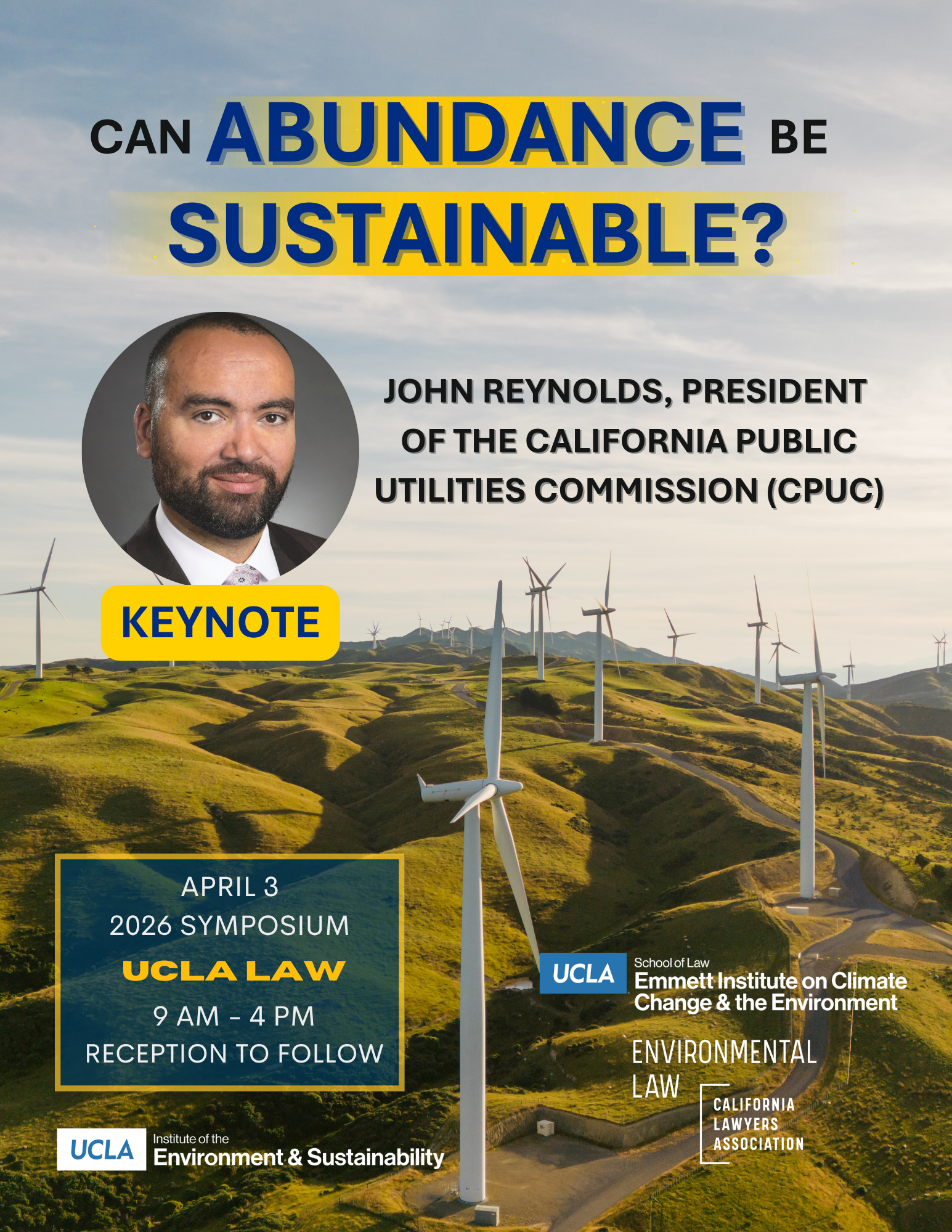
Can Abundance Be Sustainable? Merging Affordability and Climate Policy
On April 3, 2026, the UCLA Emmett Institute explored the intersection of climate goals, affordability concerns, and environmental protections by hosting a symposium titled “Can Abundance Be Sustainable?” The all-day, public event at UCLA School of Law brought together academics, community advocates, policymakers, journalists, students and—not one but two—heads of utility regulatory bodies. Watch videos of the panels below.
Keynote Speaker:
John Reynolds, President of the California Public Utilities Commission (CPUC). As the new president of the California Public Utilities Commission, Reynolds leads the state agency charged with holding utilities and companies accountable for delivering safe, reliable, affordable service to Californians. Reynolds engaged in a conversation with Professor William Boyd about the CPUC’s role in implementing California’s clean energy agenda.
Panel One: Growing the Grid Without Breaking the Bank
Meeting climate goals depends on electrification and on a transition to renewable sources of electricity. This panel addressed how electricity affordability concerns interact with climate and clean energy goals, paying particular attention to the drivers of (and responses to) growing electricity demand, the need for more transmission build-out, and recent state and federal efforts to streamline the siting and building of electricity infrastructure.
Robinson Meyer, Executive Editor of Heatmap News
Abre' Conner, Director of the Center for Environmental and Climate Justice at NAACP
Tina Andolina, Chief of Staff to California Senator Ben Allen
William Boyd, Michael J. Klein Chair and Professor of Law at UCLA Law
MCLE Materials:
-
“Affordability 101: Can We Cut American Energy Bills in Half?”: A December 2025 policy analysis by RMI, by Jacob Corvidae, et al.
-
“When Do Consumers Lose from Variable Electricity Pricing?”: A September 2025 article led by a team of researchers including M.I.T. Civil Engineering Professor Saurabh Amin
-
A Shift Key podcast hosted by our moderator Robinson Meyer dissecting the new electricity price agenda. (Listen here. Transcript here)
Panel Two: Affordability and the Transition Away from Fossil Fuels
What do affordability concerns mean for a commitment to transition away from fossil fuels as quickly as possible? The federal government’s support for the fossil fuel industry and disdain for sources of clean energy—wind energy in particular—have complicated the plans of states and localities planning to shift toward renewable energy sources and away from oil, gas, and coal. Panelists discussed the growing strain of argument that plans to transition away from fossil fuel are in tension with energy affordability and broader economic prosperity—and what that means for national and state-level efforts to promote renewable energy sources.
Allan Marks, Lecturer at UCLA Law
Katie Valenzuela, Policy Consultant at Everyday Impact Consulting and Katherine Valenzuela Consulting
Ryan Cummings, Chief of Staff of the Stanford Institute for Economic Policymaking
David Spence, Rex G. Baker Centennial Chair in Natural Resources Law and Professor of Law at the University of Texas School of Law
MCLE Materials:
-
California’s Major Wins and Losses for Climate, Clean Air, Toxics and Health: A December 2025 blog post by NRDC.
-
“Effects of Uncoordinated Electrification on Energy Burdens for Natural Gas Customers,”: A March 2025 Nature article by researchers in the Climate Action Lab at University of Wisconsin-Madison’s La Follette School of Public Affairs.
-
“Equity Implications of Net-Zero Emissions: A Multi-Model Analysis of Energy Expenditures Across Income Classes Under Economy-Wide Deep Decarbonization Policies”: A May 2024 article by a team of researchers from the Electric Power Research Institute, U.S. Department of Energy, U.S. EPA, Stanford, and MIT, among others.
Panel Three: Housing Affordability and Environmental Protection
Policymakers and advocates are wrestling with the question of whether cornerstone environmental laws and regulations, including CEQA and NEPA, can be robustly enforced while still recognizing and addressing cost-of-living pressures. This panel addressed the growing, perceived conflicts between housing affordability and environmental protection, asking whether these interests are as misaligned as they have often been portrayed to be.
Cara Horowitz, Executive Director, the UCLA Emmett Institute
Jen Ganata, Legal Department Co-Director at Communities for a Better Environment
Shane Phillips, Housing Initiative Manager at the UCLA Lewis Center for Regional Policy Studies
Liam Dillon, California Housing Reporter at Politico
MCLE Materials:
-
What Does the ‘Building an Affordable California Act’ do? A recent series of Legal Planet blog posts by Prof. Eric Biber from Berkeley Law.
-
“California Halts Building Code Updates in a Blow to Electrification”: An August 2025 Canary Media article by Alison Takemura.
-
“California’s Building Code Appeals Process: A Quiet but Crucial Lever for Housing”: Report by Ben Metcalf, Managing Director of the Terner Center for Housing Innovation at UC Berkeley.
-
Building affordable housing in California is pricey and slow. Newsom wants to fix it by consolidating power: January 20, 2026 article by panelist Liam Dillon at POLITICO.
This event was co-sponsored by the Environmental Law Section of the California Lawyers Association and UCLA's Institute of the Environment and Sustainability. UCLA School of Law is State Bar of California approved MCLE provider. Each of these three sessions is approved for 1.25 hours of MCLE credit. Please find the readings for our MCLE accredited events above. Materials will remain on this site for 30 days after the event date.