How UCLA Law student and nonprofit founder Umiemah Farrukh ’28 advances equity in education
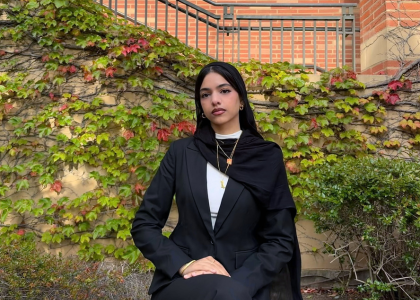
Students come from all over the world to study at UCLA School of Law. Many, before they even enter the law building, carry vast experiences and sets of skills that they will hone and then use on their journeys to make a difference in the world. Among them, some stand out for the leadership that they have shown in service.
Umiemah Farrukh ’28 certainly does. Having just finished her 1L year at UCLA Law, Farrukh is spending her first summer of law school at Weil, Gotshal & Manges, where she earned a Weil Fellowship, which goes to students who are committed to a culture of “collaboration, integrity, and innovation.” Looking at her record, it’s not hard to see why.
Farrukh – who is a child of Pakistani American parents, and who emigrated from Canada to Los Angeles – earned her undergraduate degree at UCLA alongside her siblings. Together, they founded the Farrukh Foundation, a nonprofit that is committed to “building schools and ensuring educational equity for children around the world.”
For Farrukh, law school is now the next step. Here, she talks about why she decided to continue at UCLA Law and what she expects to accomplish in her career of advocacy and impact.
Why did you start the Farrukh Foundation?
My brothers and I established it in college after a backpacking trip opened our eyes to educational poverty in the global south. I currently serve as CFO. The first school we built was in Pakistan, which is where our parents immigrated from in the late 1980s. Our work extends beyond the physical schools themselves to initiatives such as clean water infrastructure, nutritional food programs, and digital literacy training, all with the goal of expanding long-term opportunity for all children.
How did this service spark your interest in becoming a lawyer?
Working on the ground with teams of local leaders, educators, students, and policymakers, I very quickly realized the importance of strong advocacy. None of our schools would have been built if we hadn’t listened to the needs of the people we served and then advocated as strategically as possible on their behalf. I think much of that instinct comes from my experiences as a first-generation, visibly Muslim, woman of color growing up in a large family and an even larger community. I would definitely credit my mother for shaping me into someone who is deeply opinionated and unafraid to speak for those who do not have a voice, because my entire childhood, she embodied those qualities and was my sole support in a deeply patriarchal environment, giving up her own dreams to ensure I could achieve mine. I realized that lawyering was the only profession that combined everything I wanted: my passion for impactful advocacy and integrity-driven work, my leadership and research skills, my interest in a fast-paced, high-stakes career, and my background in community-driven initiatives at the foundation.
Why was UCLA Law the right place for you?
UCLA has always felt like home to me. But even beyond that initial familiarity, when I began considering law schools, I knew I wanted a top-tier institution where I could pursue both the practical and academic dimensions of impactful law and work on the kind of issues that transcend borders and time. UCLA Law is a leader in all of these arenas, where international, education/nonprofit, transactional, and business law subfields often overlap. This, coupled with its location in one of the world’s most globally connected cities, the law school’s longstanding connections to global legal practice and the populations which I hope to serve, and its collaborative culture, made it clear that UCLA Law was the only place where I could become the advocate I wanted to be. Also, what distinguishes UCLA Law is its people. When I first got my law school acceptances and was choosing between a number of top law schools, I knew that cultural fit would be very important in my decision because the people I encountered in law school would become my future colleagues, community, and friends.
Why is lawyering so important today?
Our laws protect the essence of humanity, and lawyers, in turn, protect our laws. Lawyers give a voice to those who need it to surmount their challenges, and for broader societal issues, they represent the values we hold dear as people. This is especially important because we are starting our careers at such a tenuous moment in our nation's history.
What are your plans in the long term?
I want to build a career that empowers others to pursue the futures they envision for themselves. I also hope to continue expanding the Farrukh Foundation through collaborations with institutions such as the law school’s Lowell Milken Institute for Business Law and Policy and by advocating for access to education on a broader scale. Ultimately, I want to use the law not only to solve problems but to create opportunities by helping people, organizations, and communities achieve everything they are capable of.