UCLA Entertainment Symposium celebrates 50 years at the forefront of entertainment law
June 18 event explored AI, the creator economy, and Hollywood dealmaking across a rapidly evolving industry
More than 550 people gathered on June 18 to mark the 50th annual UCLA Entertainment Symposium. Over the course of a full day of panels and programs, they reflected on the event’s half century of impact in the media and entertainment landscape and examined the issues that are reshaping the industry today.
The symposium, which UCLA School of Law’s Ziffren Institute for Media, Entertainment, Technology, and Sports Law presents each year to the leading executives, lawyers, and leaders in the entertainment business, took place at UCLA’s Schoenberg Hall and featured expert panels on artificial intelligence content, the creator economy, as well as a discussion featuring industry titans who looked back at the past 50 years of dealmaking.
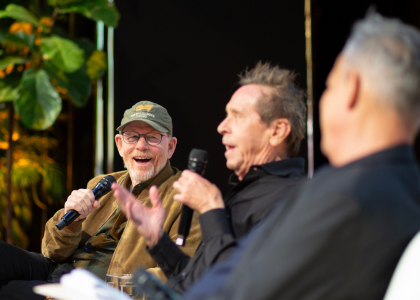
It was headlined by a keynote conversation with Imagine Entertainment founders and chairmen Brian Grazer and Ron Howard. They underscored the big themes of the day: the impact of rapid developments in technology, the ongoing challenges of producing and presenting content, and evolving audience tastes.
“Being willing to go to the audience,” Howard said, is one of the keys to ongoing creative and commercial success. “Keep observing: What really is working?” he said. “Being able to bridge these things – there’s the creative impulse, there’s a vision, there’s excitement around an idea. And then there are the gatekeepers: What do they need? What are they looking for? They’re looking for something different now. The rules are different, and everything keeps shifting because audiences are shifting along with the tech and the delivery systems.”
Howard, the director of classic movies including Splash, Apollo 13, and A Beautiful Mind, talked about how an ongoing “state of flux” is normal in the entertainment business, where he has been a major participant since he was a child actor on The Andy Griffith Show in the 1960s.
“It’s a period of tremendous change, and of course that’s stressful,” he said. “But there’s always that audience, and there are all the stories that can be told and should be told, and you just have to be willing to fight for them.”
Grazer, who has produced Howard’s movies and scores of other films and TV shows, including 24, Arrested Development, and Empire, elaborated on the looming impact of AI on the creative process.
“The movement of technology is inevitable,” he said with a knowing chuckle. “It can be very valuable,” he noted in talking about how, for example, human screenwriters can leverage AI tools to speed up and smooth out their work in creative development. “There’s tons of benefits to it, and I’m hopeful, and I believe, that it won’t be replacing people.”
Fifty years of shaping entertainment law as a distinct discipline
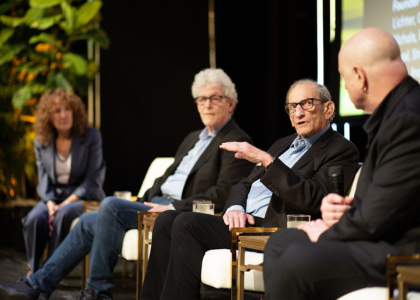
Conversations like this have been taking place at the symposium for the past five decades. Entertainment industry insiders have met at UCLA each year to hash out the latest trends in the landscape of the business and look ahead to the impact of changes on the horizon.
From the first meeting, in 1976, which was titled, “The Legal and Related Business Aspects of Independent Film Production,” installments have been variously headlined, “Where Worlds Collide: Music, Film, and Multimedia” (1995), “eHollywood” (2000), “HOLLYWORLD: The Challenges and Opportunities of Globalization” (2015), and “Fungible Hollywood: From Box Office to Bytes to Blockchain” (2022), to name a few examples.
Over time, the symposium, along with UCLA Law, has helped define entertainment law as a distinct field of practice, rather than a subset of copyright and other related legal areas.
“Fifty years ago, entertainment law in Los Angeles was very much a closed club, dominated by a handful of established firms. If you were not at one of those firms, your options were few,” recalls Michael Sherman, a member of the symposium’s advisory committee who participated in the event’s founding and has been actively involved ever since. “Knowledge about how the industry worked, and deal making, was hard to come by, and there were no dedicated entertainment law programs at the local law schools. Entertainment law was treated more as a footnote in copyright survey courses rather than a discipline in its own right.”
In that atmosphere, Sherman adds, UCLA Law made a logical home for symposium. “UCLA Law had a tradition of public engagement and interdisciplinary thinking, and the faculty understood that entertainment law touched on fundamental questions of free expression, intellectual property, labor relations, and technology,” he says.
Generating opportunities to promote this industry knowledge, with a focus on the latest developments that shape the industry and guide its future was indeed central to how the symposium defined its mission from the outset, says Cindy Lin. As the executive director of the Ziffren Institute, she spearheads UCLA Law’s vast programs in the field throughout the year and works in tandem with the symposium’s advisory committee to create an annual event that welcomes people and viewpoints from across the creative community.
“Bringing together industry leaders, legal practitioners, and academics remains central to the symposium’s impact — along with our focus on the cutting edge of where the industry is headed,” she says. “It’s just one way in which this event bolsters UCLA Law’s standing as a global hub of media and entertainment law.”
Today, the annual meeting stands as one of the most enduring UCLA Law programs – underscoring the law school’s founding mission of public service and professional excellence – and it is widely appreciated as a place where the biggest players in the business convene.
“The programming is first-rate and the keynotes are fantastic,” says Christa Workman, a veteran entertainment executive and 15-year co-chair of the UCLA Entertainment Symposium, who co-chaired this year’s event with Elsa Ramo and Craig Wagner. “The real magic happens when colleagues who normally interact only through emails, calls or contracts get to connect face-to-face, put faces to names, and build relationships. For younger execs, it’s a rare chance to meet many of the leaders shaping the industry or simply meet the person on the other side of a negotiation you’ve been working on for weeks and finally get the deal done.”
From Hollywood dealmaking to AI and the future of entertainment
UCLA Law’s dean, Michael Waterstone, offered a warm welcome to the 50th anniversary event. “This is obviously a big day for the entertainment symposium, and it’s a big day for the law school,” he said. “This is one of our longest-running and most impactful events. And it works here so well.” He noted that UCLA Law has been a leader in entertainment law for decades, going back to the work of Professor Melville Nimmer, the copyright authority who delivered the introductory address at the first symposium and served on the advisory committee for years.
“One of the things that we celebrate today is that there is no ivory tower here: We exist in partnership with industry,” he said about UCLA Law’s special location in Los Angeles and the capital of the entertainment business. “The world is moving incredibly fast, and we’re all navigating it together.”
One of the key captains of that voyage continues to be Ken Ziffren ’65, who has been a central participant in the symposium since around its founding and through his stewardship of the Ziffren Institute. He appeared on a panel titled “The Dealmakers,” alongside his fellow legal legends Linda Lichter and Donald Passman. There, they reflected on the agreements and processes that have shaped entertainment law for the past 50 years – from handshake deals that, Ziffren quipped, “generally didn’t take more than 10 minutes” to the impact that new technologies have had on the business all along the way.
Today, however, developments like business consolidation and shifts in economic and political forces have changed the calculus, Ziffren and his fellow panelists noted. But Ziffren was resolved in talking about how, for example, different industry regulations – including updated fin-syn rules and tax credits – could promote its growth in the years ahead.
Other presentations to mark the symposium’s anniversary included return visits from industry analyst Tom Wolzien, a longtime and beloved symposium speaker who discussed “50 Years in 50 Minutes: The Good, The Bad, and The Stupid,” and UCLA Law professor emeritus Paul Bergman, who delivered the John H. Mitchell Panel on Ethics and Entertainment, “Reel Justice: Ethics on Screen.”
Moving into the present – and future – another symposium panel, “The AI Content Revolution,” took stock of one of the biggest news stories today. There, Tammy Brandt of CAA, Jamie Byrne of Promise, and copyright specialist Suzy Wilson talked about the use of generative tools in the creative process and who holds creative rights or can safeguard them.
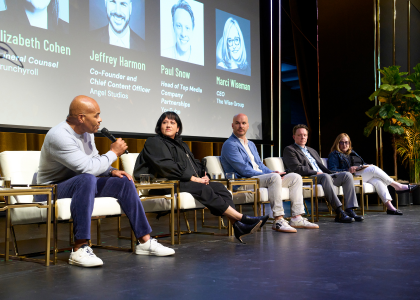
Another related view came from the panel titled “The Attention Economy: Where Content Meets Community.” Jeff Clanagan of Hartbeat, Elizabeth Cohen of Crunchyroll, Jeffrey Harmon of Angel Studios, and Paul Snow of YouTube discussed how distribution is now a force in how things get made and how creators and companies have built new audience pathways across film, television, digital video, live experiences, and fandom-driven ecosystems.
“The changes we have witnessed these past 50 years have been nothing short of extraordinary,” says Doug Lichtman, the faculty director of the Ziffren Institute. “And that’s the exciting thing about this annual event. We won’t always be right, but by gathering together each year to think about the next set of challenges and opportunities, we do our part in investing not just in each other but in the next generation of lawyers and leaders who themselves will be striving to entertain, challenge, and inspire audiences in the years ahead.”
If you missed the live event, you can buy a virtual ticket here to watch the 50th Entertainment Symposium on demand. The recording will be available from mid-July through October 2026, and MCLE credit is available. People who attended the live event will automatically receive access to the recording during this same window.